A Biography
This book is a contemporary novel in English literature.
Thus, this book can be classified within the narrative genre as a novel and further subclassified into categories such as fantasy and experimental fiction, amongst others.
This is a second edition published by Alianza Editorial in 2012; this copy is part of a fifth reprint in 2022, belonging to the ‘El libro de bolsillo/Bibliotecas de autor’ collection, featuring illustrations from the original edition. Alianza Editorial is a Spanish publishing house founded in 1966 by José Ortega Spottorno; since 1989 it has been part of the Anaya Group, which in turn has been part of Hachette Livre since 2004. It is renowned for its prestigious ‘El libro de bolsillo’ collection, created to bring culture to a wide audience, and for publishing classics of Spanish and world literature, contemporary fiction, philosophy, essays and popular science works. This book is available in English.
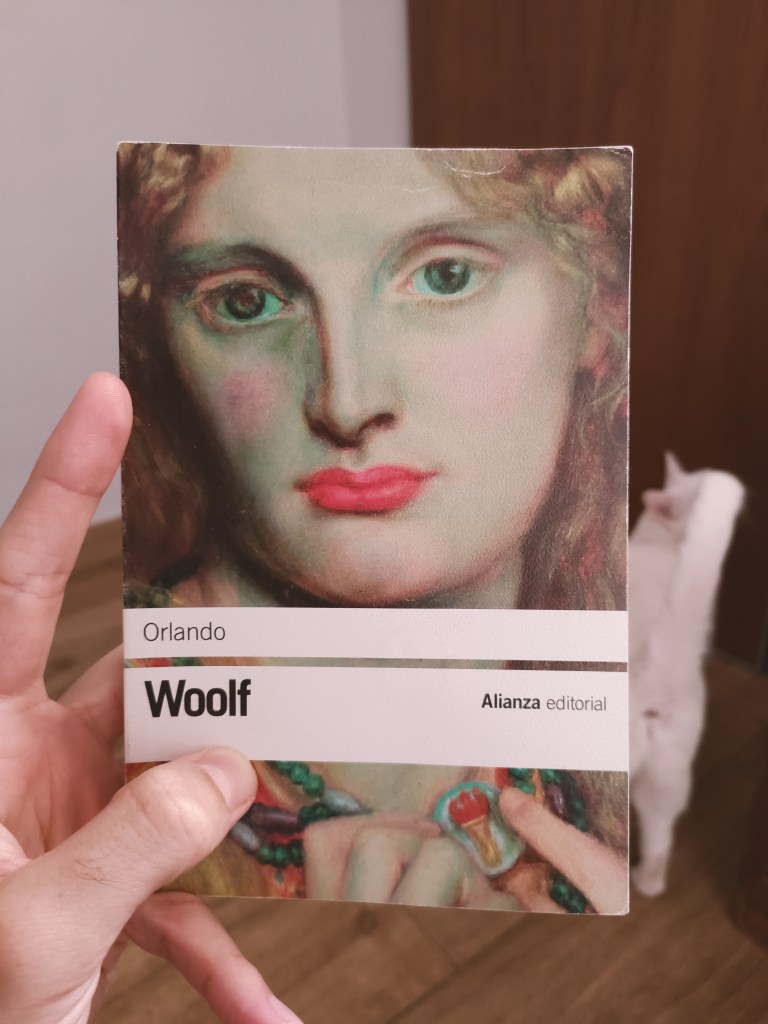
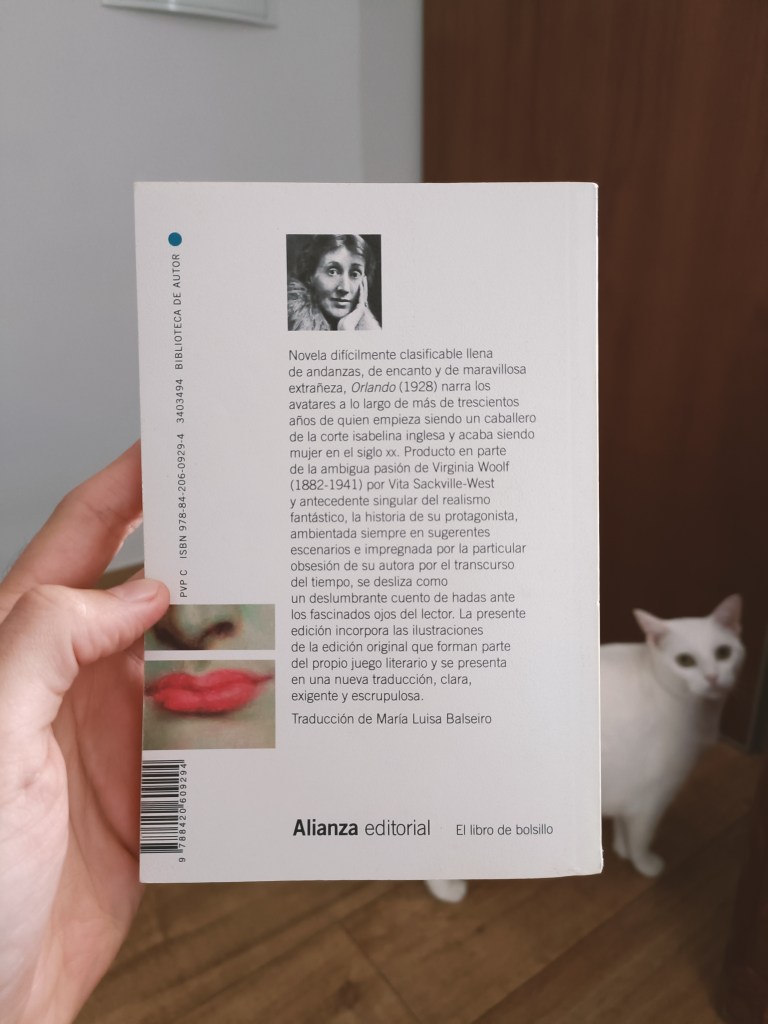
- Publication date: 1928
- Country: United Kingdom
- Pages: 304
- Reading date: October 2023
- Rating: 3/5
The author is Virginia Woolf (London, England, 1882 – Lewes, England, 1941). She was a British writer, essayist, literary critic and editor, regarded as one of the most important figures of 20th-century literary modernism. She was born Adeline Virginia Stephen into a family of intellectuals and received a broad education, mainly at home, although she also attended classes at King’s College, London. In 1912, she married the writer Leonard Woolf, with whom she founded the publishing house The Hogarth Press in 1917. She was a member of the influential Bloomsbury Group and was noted for her experimental style, particularly her use of stream of consciousness and her exploration of identity, memory and time. She was also a key figure in feminist thought. Her relationship with the writer Vita Sackville-West inspired the creation of Orlando. After suffering from various episodes of mental illness throughout her life, she died by suicide in 1941, aged 59.
Other books by the same author are:
- Mrs Dalloway (1925)
- To the Lighthouse (1927)
- A Room of One’s Own (1929)
- The Waves (1931)
- Three Guineas (1938)
Within the list of other books published by the same author, those for which there is already a post in this blog are highlighted.
Click on it to read it!
I had only ever read two essays by Virginia Woolf – which a very special person had once given me as a gift – as well as one of her novels called Mrs Dalloway. She hadn’t been an author who had particularly captivated me up to that point, although I still intended to read all her works; however, it was then that I discovered Orlando.
Orlando was one of the books I read whilst taking part in a monthly book club organised by Tuuulibrería, the second-hand bookshop in Madrid where I volunteered whilst at university. However, although my volunteering took place during that period, the book club organised by this bookshop came later, when I was already living in Zaragoza between 2021 and 2023, doing my internship in the Mental Health Nursing speciality. I missed sharing my love of reading and felt nostalgic for my time volunteering at Tuuulibrería, so when I found out they were organising a reading club, I knew straight away that I wanted to take part. Orlando was the first book for the reading club, if I remember correctly. Later on, I took part again with another book, but then, due to the distance and scheduling issues, I couldn’t carry on – though it was great fun whilst it lasted.
«Has the finger of death to be laid on the tumult of life from time to time lest it rend us asunder? Are we so made that we have to take death in small doses daily or we could not go on with the business of living? And then what strange powers are these that penetrate our most secret ways and change our most treasured possessions without our willing it? Had Orlando, worn out by the extremity of his suffering, died for a week, and then come to life again? And if so, of what nature is death and of what nature life?».
Narrator
«At one and the same time, therefore, society is everything and society is nothing. Society is the most powerful concoction in the world and society has no existence whatsoever. Such monsters the poets and the novelists alone can deal with; with such something-nothings their works are stuffed out to prodigious size; and to them with the best will in the world we are content to leave it».
Narrator
The novel centres on the life of a young English aristocrat from the Elizabethan era, who does not age over the centuries. He experiences love and heartbreak, goes on journeys and witnesses social changes. One day, whilst staying in Constantinople, he wakes up to find himself transformed into a woman. From then on, Orlando must come to terms with the various expectations and constraints that society imposes on women, whilst searching for her identity and developing her passion for literature.
The work thus covers different periods of English history up to the early 20th century. It is a work which combines fantasy, satire and philosophical reflections on gender, time and artistic creation.
In this way, the shifting historical setting allows us to observe cultural and social changes from an interesting perspective – that of Orlando – who serves as a narrative vehicle for social and feminist critique, as the author highlights the inequalities between men and women by showing how social conventions change over time. Thus, in the character of Orlando, the combination of a life spanning several centuries with a change of sex helps to challenge the usual constraints placed on individuals by time, identity and gender.
«She remembered how, as a young man, she had insisted that women must be obedient, chaste, scented, and exquisitely apparelled. ‘Now I shall have to pay in my own person for those desires,’she reflected; ‘for women are not (judging by my own short experience of the sex) obedient, chaste, scented, and exquisitely apparelled by nature. They can only attain these graces, without which they may enjoy none of the delights of life, by the most tedious discipline. There’s the hairdressing,’ she thought, ‘that alone will take an hour of my morning, there’s looking in the looking-glass, another hour; there’s staying and lacing; there’s washing and powdering; there’s changing from silk to lace and from lace to paduasoy; there’s being chaste year in year out…’ Here she tossed her foot impatiently, and showed an inch or two of calf. A sailor on the mast, who happened to look down at the moment, started so violently that he missed his footing and only saved himself by the skin of his teeth».
Narrator
«The man looks the world full in the face, as if it were made for his uses and fashioned to his liking. The woman takes a sidelong glance at it, full of subtlety, even of suspicion. Had they both worn the same clothes, it is possible that their outlook might have been the same.
That is the view of some philosophers and wise ones, but on the whole, we incline to another. The difference between the sexes is, happily, one of great profundity. Clothes are but a symbol of omething hid deep beneath. It was a change in Orlando herself that dictated her choice of a woman’s dress and of a woman’s sex. And perhaps in this she was only expressing rather more openly than usual–openness indeed was the soul of her nature–something that happens to most people without being thus plainly expressed. For here again, we come to a dilemma. Different though the sexes are, they intermix. In every human being a vacillation from one sex to the other takes place, and often it is only the clothes that keep the male or female likeness, while underneath the sex is the very opposite of what it is above. Of the complications and confusions which thus result everyone has had experience; but here we leave the general question and note only the odd effect it had in the particular case of Orlando herself.
For it was this mixture in her of man and woman, one being uppermost and then the other, that often gave her conduct an unexpected turn. The curious of her own sex would argue, for example, if Orlando was a woman, how did she never take more than ten minutes to dress? And were not her clothes chosen rather at random, and sometimes worn rather shabby? And then they would say, still, she has none of the formality of a man, or a man’s love of power».
Narrator
In relation to what has already been described, it is worth highlighting the novel’s originality in terms of its classification, as it combines various subgenres. Woolf manages to ensure a single novel is regarded as fantasy (due to the protagonist’s extraordinary longevity and his gender transformation), experimental (due to its innovative structure and narrative techniques), historical (as it spans different periods of English history), satirical (offering social and feminist criticism) and modernist (exploring subjectivity and formal experimentation). Furthermore, it is written in the form of a biography, imitating and parodying the genre, as Orlando’s is a fictional biography.
«Life seemed to him of prodigious length. Yet even so, it went like a flash. But even when it stretched longest and the moments swelled biggest and he seemed to wander alone in deserts of vast eternity, there was no time for the smoothing out and deciphering of those scored parchments which thirty years among men and women had rolled tight in his heart and brain. Long before he had done thinking about Love (the oak tree had put forth its leaves and shaken them to the ground a dozen times in the process) Ambition would jostle it off the field, to be replaced by Friendship or Literature. And as the first question had not been settled–What is Love?– back it would come at the least provocation or none, and hustle Books or Metaphors of What one lives for into the margin, there to wait till they saw their chance to rush into the field again».
Narrator
On the other hand, the pace of the narrative is uneven, as some episodes in Orlando’s story move along briskly whilst others linger over lengthy, albeit stimulating, reflections or descriptions. Furthermore, there are numerous references to English history, customs and writers, which may occasionally leave some readers feeling lost without the necessary context (as happened to me at certain points whilst reading). Woolf also employs a narrative style characterised by frequent jumps and shifts in point of view, which can make it difficult to follow the story closely. In particular, towards the end of the book, I found the writing more demanding and dense, perhaps due to its experimental nature. In my case, on the one hand this stimulated me, given the creativity of Woolf’s writing in this novel, whilst on the other hand it made it difficult for me to connect with Orlando when the emphasis lies more on the experimental nature of the work and less on connecting with the character. The following passage is an example of what I mean by moments when you can connect with the character, but a long and drawn-out experimental narrative with multiple associations pulls you away from that connection:
«My hands shall wear no wedding ring,’ she continued, slipping it from her finger. ‘The roots shall twine about them. Ah!’ she sighed, pressing her head luxuriously on its spongy pillow, ‘I have sought happiness through many ages and not found it; fame and missed it; love and not known it; life–and behold, death is better. I have known many men and many women,’ she continued; ‘none have I understood. It is better that I should lie at peace here with only the sky above me–as the gipsy told me years ago. That was in Turkey.’
And she looked straight up into the marvellous golden foam into which the clouds had churned themselves, and saw next moment a track in it, and camels passing in single file through the rocky desert among clouds of red dust; and then, when the camels had passed, there were only mountains, very high and full of clefts and with pinnacles of rock, and she fancied she heard goat bells ringing in their passes, and in their folds were fields of irises and gentian. So the sky changed and her eyes slowly lowered themselves down and down till they came to the rain-darkened earth and saw the great hump of the South Downs, flowing in one wave along the coast; and where the land parted, there was the sea, the sea with ships passing; and she fancied she heard a gun far out at sea, and thought at first, ‘That’s the Armada,’ and then thought ‘No, it’s Nelson’, and then remembered how those wars were over and the ships were busy merchant ships; and the sails on the winding river were those of pleasure boats. She saw, too, cattle sprinkled on the dark fields, sheep and cows, and she saw the lights coming here and there in farmhouse windows, and lanterns moving among the cattle as the shepherd went his rounds and the cowman; and then the lights went out and the stars rose and tangled themselves about the sky. Indeed, she was falling asleep with the wet feathers on her face and her ear pressed to the ground when she heard, deep within, some hammer on an anvil, or was it a heart beating? Tick-tock, tick-tock, so it hammered, so it beat, the anvil, or the heart in the middle of the earth; until, as she listened, she thought it changed to the trot of a horse’s hoofs; one, two, three, four, she counted; then she heard a stumble; then, as it came nearer and nearer, she could hear the crack of a twig and the suck of the wet bog in its hoofs. The horse was almost on her. She sat upright. Towering dark against the yellowslashed sky of dawn, with the plovers rising and falling about him, she saw a man on horseback. He started. The horse stopped.
– ‘Madam,’ the man cried, leaping to the ground, ‘you’re hurt!’
Narrator
-‘I’m dead, sir!’ she replied».
In conclusion, I found Orlando to be a highly original, intelligent and thought-provoking novel. One of its greatest strengths is the social critique Virginia Woolf develops with irony and subtlety, particularly regarding gender conventions. The fact that Orlando spans several centuries and undergoes a change of sex strikes me as an extraordinarily creative narrative device, which allows the exploration of how social expectations regarding what it means to be a man or a woman vary from one era to the next.
I have also enjoyed its witty prose, the reflections on literary creation, nature and human relationships, as well as its unique way of combining various subgenres of the novel. However, the final fifty pages have marred my overall assessment. In this section, Woolf intensifies her narrative experimentation to such an extent that the prose becomes denser and more fragmentary, the plot thread becomes diluted and the reading loses its flow, making it difficult to connect with the protagonist. Whilst I understand that this is a deliberate stylistic choice which others may appreciate, in my case, it has personally distanced me from a story which I had been thoroughly enjoying up to that point.
I think this raises the question of to what extent a novel can experiment with its form without sacrificing the reader’s connection to the story. Personally, I enjoy experimentation when it enriches the story, but not when it hinders my engagement with it. I suppose it’s all about striking a balance between originality and readability – which is often tricky – as well as appealing to all readers.
«It was a fine night early in April. A myriad stars mingling with the light of a sickle moon, which again was enforced by the street lamps, made a light infinitely becoming to the human countenance and to the architecture of Mr Wren. Everything appeared in its tenderest form, yet, just as it seemed on the point of dissolution, some drop of silver sharpened it to animation. Thus it was that talk should be, thought Orlando (indulging in foolish reverie); that society should be, that friendship should be, that love should be. For, Heaven knows why, just as we have lost faith in human intercourse some random collocation of barns and trees or a haystack and a waggon presents us with so perfect a symbol of what is unattainable that we begin the search again».
Narrator
Some reflections:
- Are the differences between men and women as natural as we think, or are they largely the result of cultural constructs?
- How would our understanding of life change if we could live for several centuries?
- How much of our identity truly belongs to us, and how much is determined by the era and society in which we live?
Type your e-mail address and click on subscribe to be notified of new content!
- Orlando
- Orlando
- Dewey
- Dewey Lee Más Libros
- One hundred unique stories in one hundred words
- Cien relatos irrepetibles de cien palabras
- Canciones del príncipe Vogelfrey
- Songs of Prince Vogelfrei
- A bestiary of prehistory
- Un bestiario de la prehistoria
Cambia el idioma a:


Which are the latest blog posts?