This book is a popular science work aimed at introducing Philosophy to the non-specialist reader and teaching them to think critically about everyday problems.
It can therefore be classified within the didactic genre as a popular sociopolitical text, more specifically on the subject of education.
This is a first edition published by MiráHadas, a Spanish publishing house linked to another called Babidi-Bú. The latter was founded in 2013 and publishes books aimed at children and young people, whilst MiráHadas, founded in 2015, focuses on literature for adults. Both imprints are committed to and facilitate the publication of works by new authors. MiráHadas’s catalogue is quite extensive, with contemporary fiction making up the bulk of it. This book has not been translated into English.
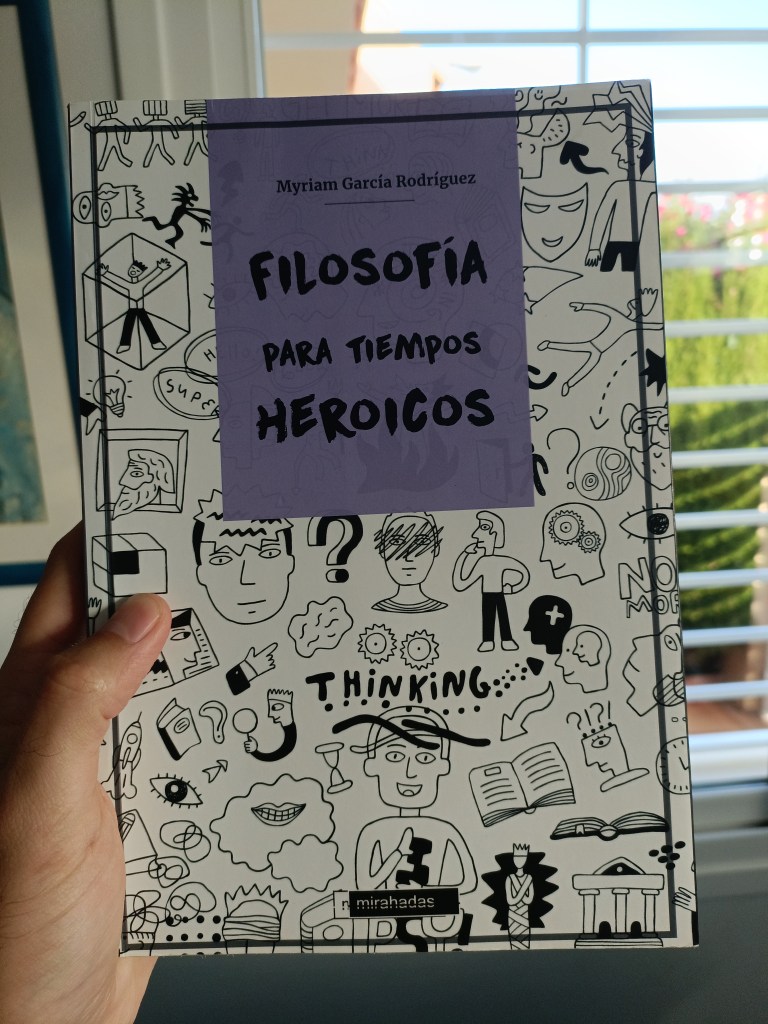
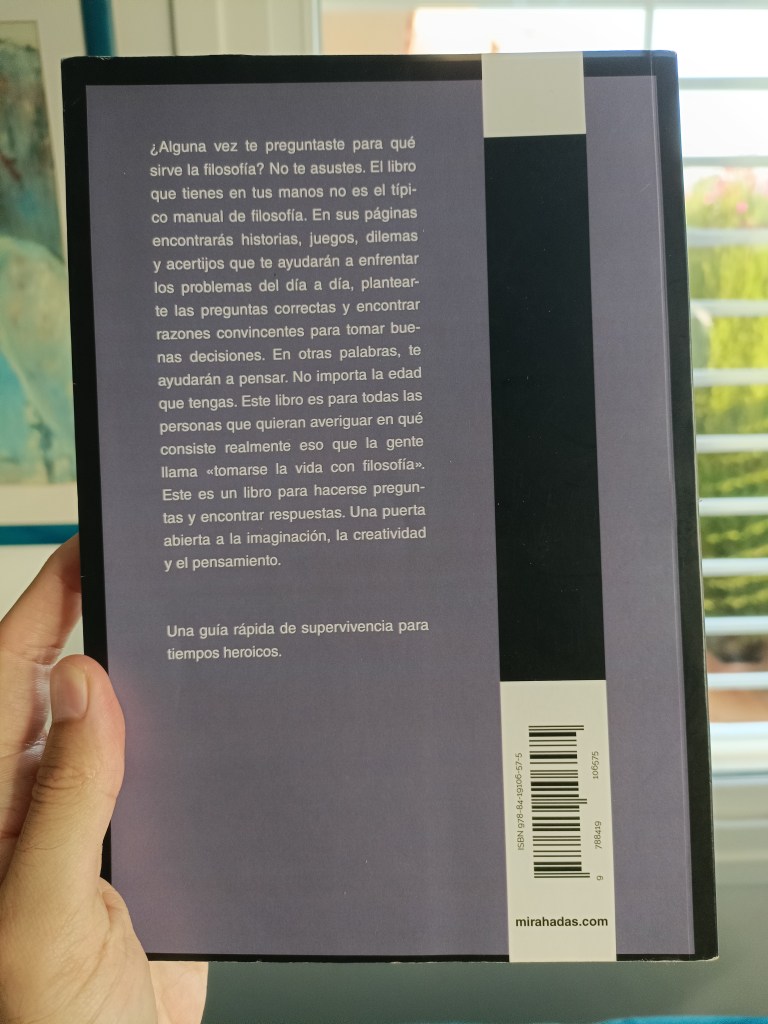
- Publication date: 2022
- Country: Spain
- Pages: 169
- Reading date: March 2023
- Rating: 4/5
As for the author, Myriam García Rodríguez (Oviedo, Spain, 1981–) is a Spanish philosopher, researcher, lecturer and science communicator. She holds a PhD in Philosophy and a Master’s degree in Social Studies of Science and Technology from the University of Oviedo. Her academic career has focused particularly on the Philosophy of Science, scientific culture and the teaching of Philosophy, with a special interest in the Philosophy for Children programme, as she is the director of the Filonenos Association in Asturias. As well as teaching Philosophy, she carries out important work in popularising and educating people about Philosophy, promoting dialogue and critical thinking amongst children and young people; this commitment to popularising Philosophy is also the inspiration behind this book.
At the beginning of 2022 I discovered a book by Chema Sánchez in a bookshop in Madrid where I worked as a volunteer for some months time ago. That book was El radiofonista pirado. It was my first contact with a text related to the Escuela de Pensamiento Libre. From then on I started to investigate what Filosofía para Niños was. I discovered their educational approach to be very stimulating and interesting. Since then I have only wanted to learn more about the project and the ideas behind it, as well as about the authors who nurture it.
On social media, some time after following the Spanish Association for Philosophy for Children, I saw an announcement about the publication of this book by an author linked to that association. The book’s premise – an introduction to philosophical thought for those unfamiliar with it – really piqued my curiosity, so I decided to buy it and read it as soon as it arrived in the post.
«An interpretation that remains as relevant as ever. Most people do not question the information they receive and prefer to believe the comforting lies that appeal to our most basic emotions, using them to underpin a ‘truth’ that is not really true, but which we want to believe. Fake news has a field day whilst we freely choose to live in a state of perpetual hypnosis».
Myriam García Rodríguez
I found the book an enjoyable and quick read, as the philosophical ideas it explains do not require any prior knowledge and are not written in academic language. As such, it is an accessible and concise popular science book that may be useful for people who are curious about Philosophy or for young people.
The book seeks to move away from teaching Philosophy as a history of authors and theories, and instead presents it as an activity that helps us to ask questions, argue, engage in dialogue and make decisions in our everyday lives.
Through stories, games, riddles and dilemmas, it brings to life a subject that many find daunting because it can sometimes be too theoretical. It is interesting to see how it addresses critical thinking, decision-making and the use of play as a learning method.
«Neil Postman defined ‘disinformation’ as confusing, incomplete or biased information that leads us to believe we know something when in fact it distances us from knowledge. And that is exactly what is happening to us. We live under the spell that information overload casts over our beliefs about reality, the truth and their consequences. Every day we receive a huge amount of information through the media and social media. The speed at which news is published, shared and retweeted makes it increasingly difficult to determine its veracity. Most people use ‘homemade’ filters. We tend to believe what comes from our inner circle, and we are more likely to accept posts that have received the most ‘Likes’. If, on top of that, the information aligns with our own beliefs and opinions, we believe ourselves to be safe from deception. But just because something seems true does not mean it is. So, how can we tell what is true and what is false? We must try to move as far away as possible from intuition and turn to more reliable strategies such as the laws of logical reasoning, distinguishing between better and worse arguments, and good and bad reasons”.
«People often think that play is a purely recreational activity, often trivial, which, at best, entertains us and, at worst, distracts us from our daily tasks and responsibilities. However, play is a much more complex and meaningful activity than is generally realised. Several scientific studies show that play enhances the quality and resilience of our nervous system, aids socialisation and improves our cognitive abilities. Through playing with others, and on their own, children learn to understand themselves better, identifying their strengths and weaknesses. Every game involves a certain degree of difficulty, with challenges and obstacles that must be overcome within a specific time and space. This effort and tension in play stimulate the development of our own aptitudes and skills, and foster creative ways of solving problems. Behind its playful nature, play conceals extraordinary potential for personal growth, which leads to self-esteem and an improved quality of life”.
Myriam García Rodríguez
On the other hand, the book’s greatest strength is also its weakness. I believe that, in its aim to be accessible, concise and practical, it may fall short for those with a background in philosophy. Nevertheless, I think it is worth refreshing one’s understanding of certain concepts.
Furthermore, the fact that the book is commercially categorised as self-help in some shops raises the question of whether applying philosophy to everyday problems actually works, or whether at times it bears too close a resemblance to the discourse of personal development.
On another note, many of the book’s resources – such as riddles, games and questions – work best in a shared reading setting, rather than for an individual reader. This is worth bearing in mind, as it alters the experience of the book.
«Empathy, solidarity, individual responsibility and collective effort are ethical values that will be fundamental in the society that lies ahead. To reflect on all this is to philosophise. As Terence said in the 2nd century BC, ‘nothing human is alien to me’. But not in the sense that I care more or less about it, but in the sense that every action of others influences us, and every action of our own has consequences for the reality of others. This spirit of active engagement, combined with the pursuit of what is good, just and beautiful in the world, and the use of the creative and intellectual powers with which we are endowed, are, in my view, the three most important contributions of philosophy to helping us face the times in which we live. These are heroic times that call on us to take life in our stride. Improving this ability depends largely on practice. It is therefore essential that we all have the opportunity to engage in dialogue on unresolved issues that require deliberation. This will help to develop the skills that enable critical, independent, creative and thoughtful thinking.”resueltas y que requieren deliberación. Ello va a ayudar al desarrollo de habilidades que posibiliten un pensamiento crítico, autónomo, creativo y cuidadoso».
Myriam García Rodríguez
In conclusion, reading this book has not taught me anything I did not already know about Philosophy, as it is a field I have been exploring for some time. However, I can say that I have learnt about – or at least gained an insight into – the difference between teaching Philosophy and teaching how to philosophise. And exploring the idea of using play as a way of teaching how to philosophise has struck me as original and enriching.
Some reflections:
- What is your view on what Philosophy is? Do you consider it an important subject?
- What does critical thinking mean to you?
- Can you recall any playing experiences from your childhood or teenage years that you feel taught you something about life or about yourself?
Type your e-mail address and click on subscribe to be notified of new content!
Which are the latest blog posts?
- Dewey
- Dewey Lee Más Libros
- One hundred unique stories in one hundred words
- Cien relatos irrepetibles de cien palabras
- Canciones del príncipe Vogelfrey
- Songs of Prince Vogelfrei
- A bestiary of prehistory
- Un bestiario de la prehistoria
- Los límites de mi lenguaje: Meditaciones sobre la depresión
- The limits of my language: Meditations on depression
Cambia el idioma a: