This book is the autobiographical testimony of an anonymous woman who recounts the sexual abuse she suffered during her childhood and adolescence at the hands of her father and the profound impact these experiences had on her adult life.
Thus, this work can be classified within the didactic genre, in the form of memoirs, and further classified under the category of diary and confessional literature, due to its intimate nature and the raw honesty of its narrative.
This is the first edition from 2017, published by Malpaso Ediciones, an independent publishing house founded in Barcelona in 2013 and dedicated to publishing works of fiction, essays and contemporary literature. This book is available in English.
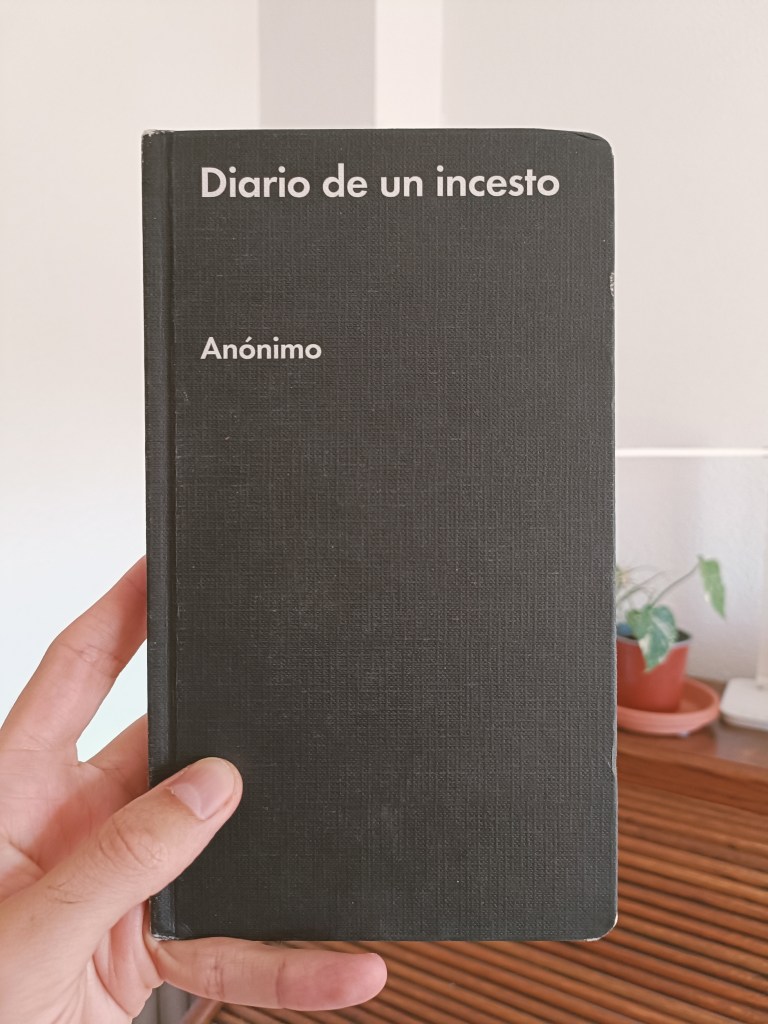
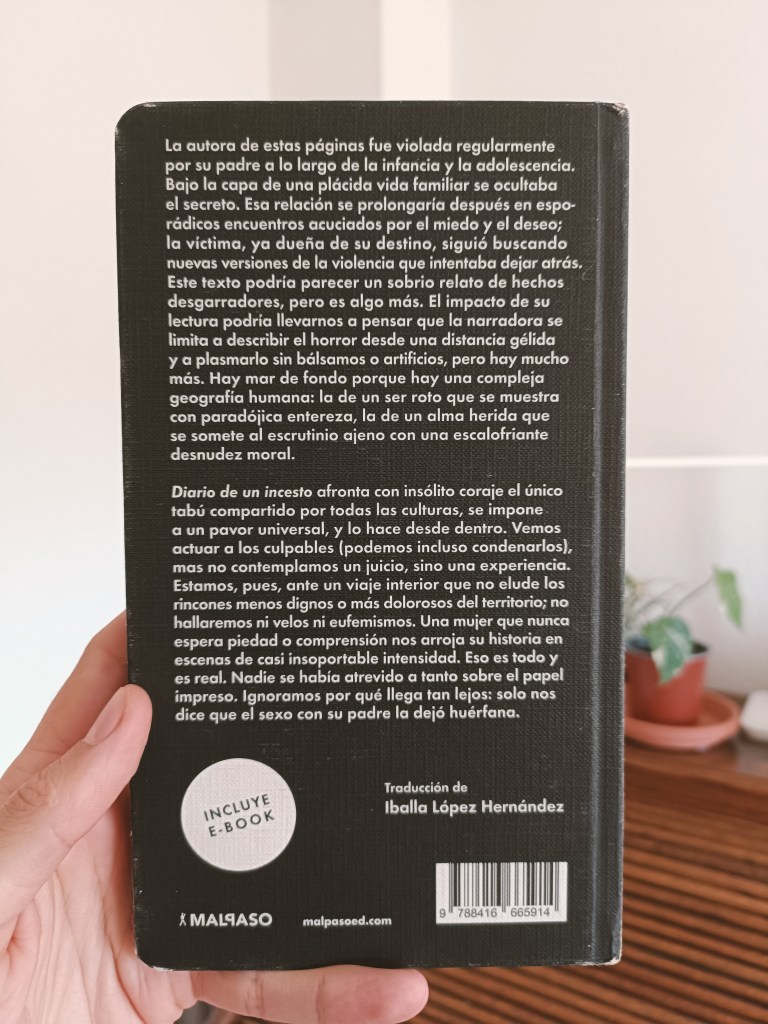
- Publication date: 2017
- Country: USA
- Pages: 128
- Reading date: April 2021
- Rating: 4/5
The author of The Incest Diary has chosen to remain anonymous in order to protect her privacy and that of those connected to her story. For this reason, biographical details such as her name, date and place of birth are unknown. According to information released to mark the book’s publication, she is believed to be a practising poet and journalist, although these details have not been publicly confirmed.

Whilst I was volunteering at Tuuulibrería in Madrid during my degree, someone told me about this book. They described it as the hardest book they’d ever had to read, because of its heart-wrenching plot. As I was already interested in Psychology, it sparked my curiosity and I decided to buy it and read it.
The Incest Diary is the autobiographical testimony of an anonymous woman who recounts the physical, psychological and sexual abuse she suffered at the hands of her father from childhood, through her adolescence and into her youth. She also describes the moment when she decided to cut off all contact with her paternal figure. However, she explains how this physical separation did not mark the end of her suffering, as the abuse left lasting effects that shaped her identity, her sexuality and her personal relationships in adulthood.
The book does not present a story of personal triumph, but rather explores the persistence of trauma, the dissociative symptoms developed as a means of survival, and the impossibility of fully regaining the sense of security and trust that were damaged during her childhood.
«Perhaps everything I write has something to do with the fact that my father raped me before I could read or write».
Anonymous

Whilst reading the diary, the first thing which caught my attention was the complete absence of euphemisms and the raw, unvarnished language the author uses to convey her experience. She describes events without sugar-coating them; she makes no effort to make them more bearable for the reader. This results in a narrative rawness that is truly striking. Whilst I found this to be a commendable aspect, I am also aware that it limits the book’s accessibility for many people for whom the extreme frankness of the events described may prove an emotionally draining and difficult experience. In other words, reading the book means the reader is confronted with a reality that is usually silenced: that of family abuse.
On the other hand, phenomena such as dissociation are frequently described as forms of survival or relief for the author. However, in my experience as a reader, I found no moments of relief whilst reading, as the book conveys darkness, fear and helplessness throughout, resulting in an atmosphere which I found claustrophobic and suffocating.
«I long for him and I’d kill him; I’d throw his body to the dogs».
Anonymous
As for the narrative, it constantly returns to the trauma and its consequences, which may give the impression that the plot is going nowhere; however, in my opinion, I believe it is intended to reflect the persistence of traumatic memories. Furthermore, I do believe the narrative structure is subordinate to the emotional impact of the work. It is a book which seeks a direct expression of the traumatic experience rather than focusing on literary aspects such as scene construction, pacing, and so on. Moreover, it does not delve into the family and social context of the abuse suffered by the author; rather, the intention seems to be, at all times, to convey the victim’s inner experience.
«I reduced him to an object, just as I reduced myself to an object for him».
Anonymous
Far from achieving a definitive or hopeful release, the author breaks with the traditional narrative of overcoming adversity. The book left me with a profound sense of helplessness and claustrophobia, as the trauma remains present even after she has broken contact with her father, which helps to illustrate the lasting effects of abuse. The significance of this conclusion left me with a lingering sense of unease, and after much reflection, I believe that is precisely the author’s intention. The absence of a cathartic resolution or emotional liberation in the story does not mean it fails as a narrative.
In my opinion, and in conclusion, refusing to write a happy ending may well be a significant literary choice, as its value as a work or testimony lies rather in the unease it provokes.
«Sex with my father left me an orphan».
Anonymous
Some reflections:
- Do you think that crude language is necessary to convey certain experiences?
- What differences do you find between reading an autobiographical testimony and a work of fiction on a similar subject?
- Do you think that writing about a traumatic experience can aid recovery, even if it does not lead to a definitive sense of release?
Type your e-mail address and click on subscribe to be notified of new content!
- The Incest Diary
- Diario de un incesto
- Pau, el hombre que mira lejos
- Pau, the Man Who Gazes into the Distance
- Orlando
- Orlando
- Dewey
- Dewey Lee Más Libros
- One hundred unique stories in one hundred words
- Cien relatos irrepetibles de cien palabras
Cambia el idioma a:



Which are the latest blog posts?