This book is a personal and philosophical essay on the experience of living with depression.
This book can therefore be classified within the didactic genre as an essay and further categorised within the field of Psychology.
This is a first edition published by Katz Editores. The publishing house was founded in 2006 and aims to contribute to the spread of knowledge, as well as to challenge many of the ideas shaping contemporary worldviews. They define themselves as a space for diverse dialogue and a forum for critical exchange. As such, they seek to cover texts on politics, sociology, history, cultural studies, law, communication and other disciplines. This book is available in English.
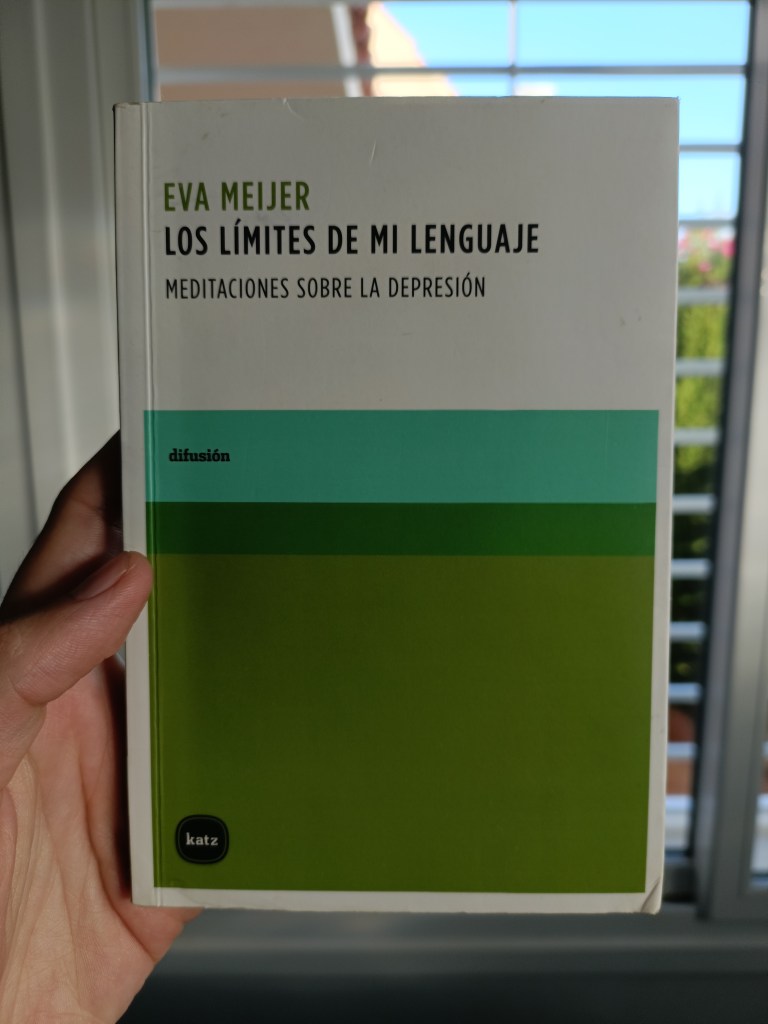
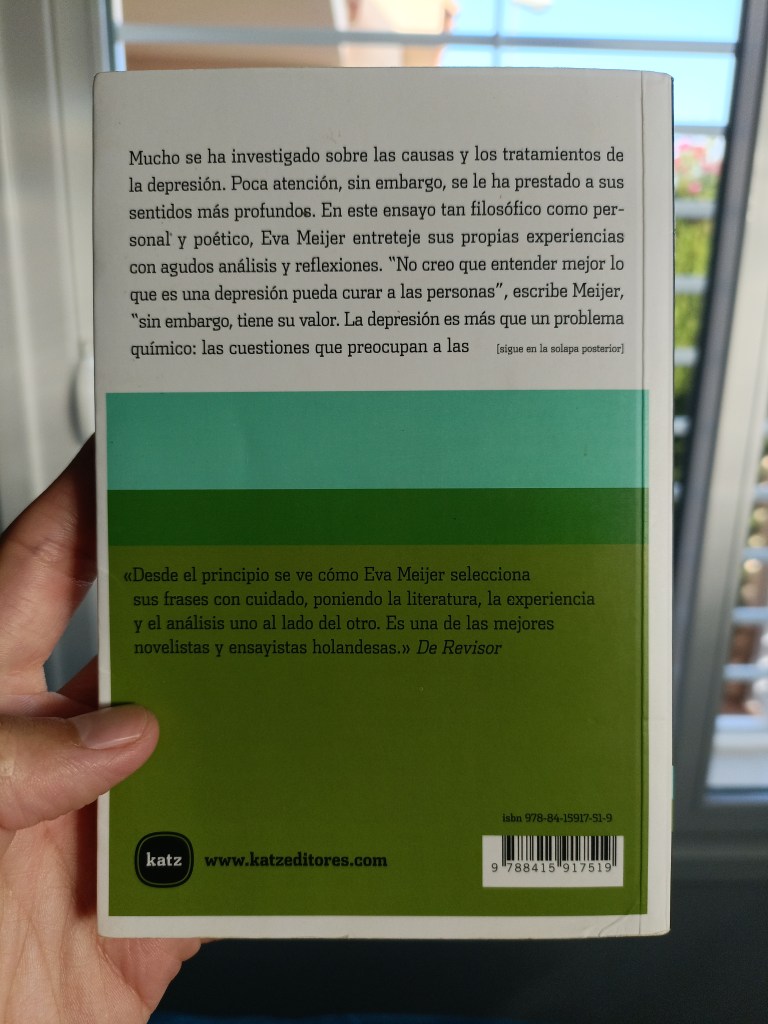
- Publication date: 2019
- Country: Netherlands
- Pages: 141
- Reading date: August 2023
- Rating: 5/5
About the author of the book, Eva Meijer (Hoorn, Netherlands, 1980–) is a writer, philosopher and artist, recognised for her work exploring the relationships between humans, animals, language and politics. Trained in Fine Arts and Philosophy, Meijer was awarded a PhD cum laude in Philosophy from the University of Amsterdam in 2017. Throughout her career, she has combined academic research with literature, challenging the boundaries traditionally separating human experience from that of other animals. Her book «When Animals Speak: Toward an Interspecies Democracy», published in 2019, was awarded the ASCA Book Award in 2020. She has published nine novels, as well as numerous short stories and poems.
Other books published by her are:

Within the list of other books published by the same author, those for which there is already a post in this blog are highlighted.
Click on it to read it!
After finishing my Internship as a Mental Health Nursing Resident (EIR) in Zaragoza, I decided to take a sabbatical summer and went on several trips during that time. One of them was a trip to Benidorm with my mum and my brother. I read this book at that time. I can’t remember where I bought it – whether it was online, at a talk, or in a bookshop. The point is that it was a very timely read. I was able to take my mind off the subject of mental health, yet at the same time not forget what’s important, thanks to reading this book, which I fondly remember as one of my favourites from 2023.
«This essay reflects this; it is a brief philosophical exploration of depression in which I draw on my own experiences. Not to lay myself completely bare without omitting a single detail, as Rousseau writes at the beginning of Confessions. I am not interested in sketching a true picture of my life to date or in creating a self-portrait; I use my own life as a lens through which to investigate the structure and meaning of depression. This is only a small part of what I could say about myself (and facts turned into words always diverge from the events on which they are based); but it is nonetheless an important part of my life, and something that has shaped me profoundly. I do not believe that a better understanding of what depression is can cure people. And yet, it has its value. Depression is more than a chemical problem: the issues that trouble people with depression are fundamental to the human condition. Furthermore, they are linked to all sorts of philosophical questions, such as the relationship between body and mind, language, autonomy, power relations and loneliness. This essay also deals with the other side of depression: animals, trees, other people, art; it deals with comfort and hope, and what can give meaning to life«.
Eva Meijer
In this work, Eva Meijer reflects on the experience of living with depression. Her reflection is not merely clinical, but also human, philosophical and poetic. It is not a book intended to assert any kind of absolute truth, but rather a work in which she reveals, in a personal and unique way, her own experience of depression and analyses many of these experiences through the lens of philosophical ideas. Throughout the book, the author engages in dialogue with various philosophers and authors in an attempt to understand her own experience.
«I didn’t feel ill; it seemed to me that I was a bad person, and everything I did was about getting rid of that feeling or pushing it aside. Night after night I would sit on the windowsill listening to music and smoking hand-rolled cigarettes, whilst writing poems, songs and also letters, which I would sometimes burn afterwards. Everything revolved around an abyss: this is how it is, I’m here alone, I do everything wrong; and so on».
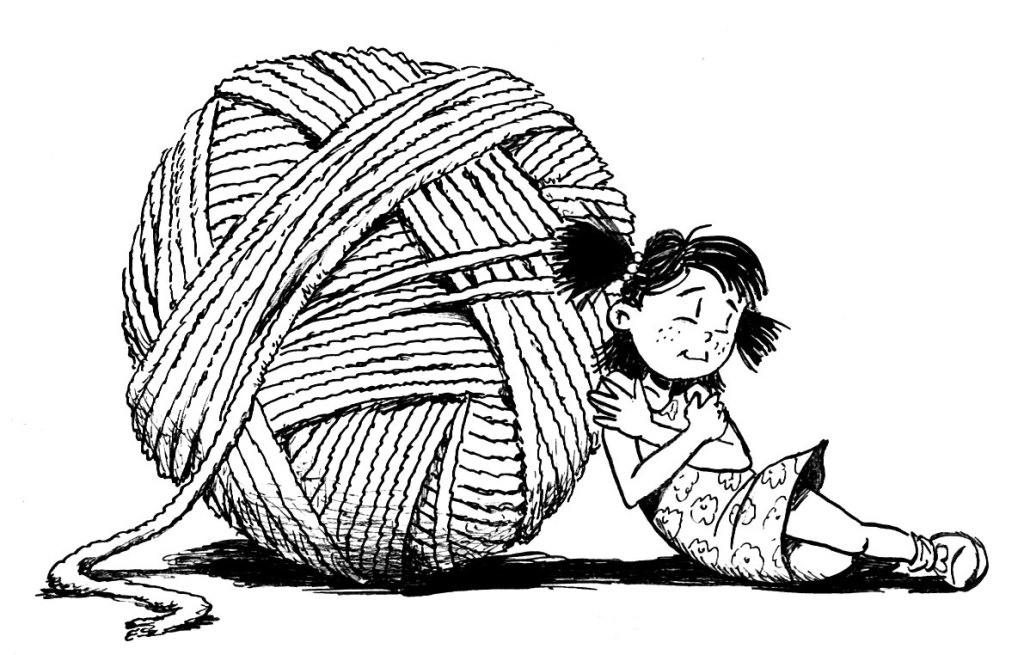
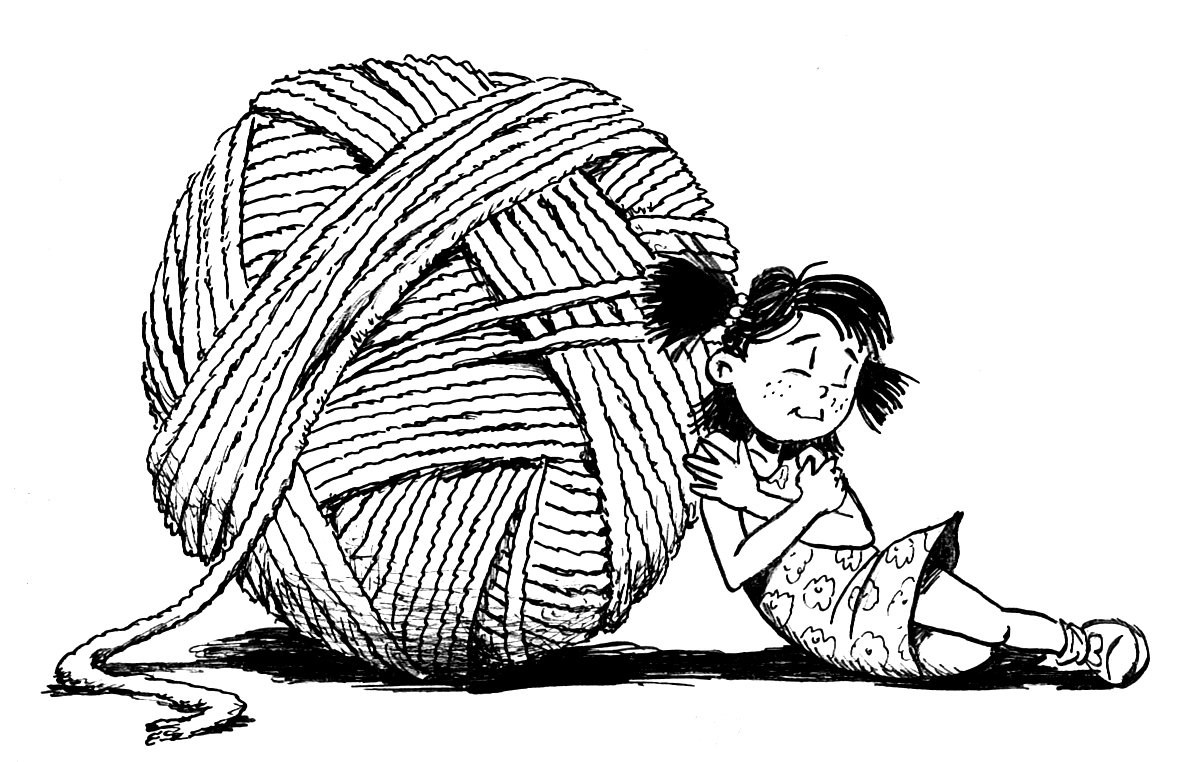
«I see some of those thoughts (that I’m a bad person, that it’s all my fault) as largely untrue, and when they come back to me – in moments of tiredness, sadness or loneliness – I’m able to put them on hold. I can realise that, whilst it’s true I’m thinking those things at that moment, the situation is going to change; I’m tired or sad or feeling lonely, and it’s only natural that I should think that way. These thoughts don’t say anything about me; they say something about how my mind works. I usually realise this, but not always. When both life and my thoughts fall apart, become tangled and weave their dark threads around me, that technique no longer works quite so well for me. Then I start sleeping worse, and when I sleep worse I can no longer put things into perspective, and the wrong thoughts take root inside me, turning into feelings and vice versa; then they become covered in mould, which, after smothering joy, smothers logic, blurring it, until everything becomes grey and hazy”.
Eva Meijer
By not separating the definition of the symptoms of depression from, on the other hand, the actual experience of feeling depressed, the author succeeds in crafting poetic descriptions of great depth and meaning, in which the phenomenology of psychological suffering carries significant weight, rather than merely diagnostic or clinical language. Rather than presenting depression simply as sadness, she broadens the analysis to explore how one’s perception of time, the body, everyday life and relationships with others changes. This is something that is hard to find in other, more clinical books on depression.
«Often, when people write or talk about depression, they use strong words. I’ve always been averse to comparing depression to monsters, demons or beasts (especially dogs – after all, what have they done to deserve it?), and also to metaphors involving the colour black. Partly because these images are clichés, and partly because I see depression more as an absence than as a presence. Everything of value gradually fades away, and what remains is a bare rock. Fear and sadness can cause an excess of emotion; depression, on the other hand, strips away positive feelings until everything becomes more inhospitable and empty, leaving the way clear for negative feelings. Whilst fear or sadness often relate to what is worthwhile, depression shows that nothing is worthwhile. Nor is depression black, let alone pitch black. Dark, perhaps, in the sense that a night is dark when light withdraws from the world, so that the surroundings seem more dangerous and one cannot find one’s bearings as well: everything is silent, more so than during the day, and what remains there is harder to see”.
«In depression, moreover, the dimensions of time become intertwined. The future turns into a sort of repetition of the present (with a bit of luck you manage to get through the day, but often it’s a matter of enduring each moment), whilst the past becomes a strange fiction, more distant than usual: you know it was once good, but you find it incomprehensible how; it’s something you merely know but cannot feel. During a bout of depression, you find yourself faced with a new map of your life: everything that has happened up to that point is laid out before you once more, but this time from the perspective of depression. Events are coloured by memories, but the reverse also happens: memories take on the hue of your mood at any given moment. The past is not fixed; it haunts you (and, like any good pursuer, it regularly changes its disguise). Despair takes you back to a previous despair, which reinforces it, just as sadness brings another earlier sadness to the surface. Matters from the past can emerge unexpectedly; and during a bout of depression, it is always the bad things that surface, never the good ones. What you’re left with is an empty ‘now’: you can no longer find your bearings in time”.
Eva Meijer
Nor does the author limit herself to discussing depression, sadness or melancholy; she also tackles issues linked to communication. Topics such as vulnerability, sensitivity and the very nature of language are subjected to careful reflection, interwoven with the book’s central theme. Furthermore, as with the rest of the work, the poetic and complex nature of the themes addressed, in my opinion, does not hinder comprehension, as the language remains accessible and everyday.
«Incidentally, the simple act of talking to others – which is often seen as important or desirable for those struggling with mental health issues – is not always an option. During a bout of depression, we often have to put all our energy just into keeping ourselves going, and talking to friends or family can make this more difficult: it also confronts us with their sadness, their fear, their worries and their disbelief (of these, disbelief is the easiest to deal with). And sometimes talking is literally impossible: we may be at a loss for words. Depression isolates people from the rest of the world; it makes everything feel dead and cold”.
«Language can bridge the gap between us and others, yet it is also what separates us from them: just like our skin. Those who have a wider vocabulary, even if their emotional life is no richer than that of others (music is as rich as language, different languages offer different forms of expression, and many animals have non-verbal forms of communication), do have a richer palette with which to interpret and make sense of that emotional life».
«It also works the other way round: perhaps my sensitivity is the main reason why I get depressed, but it is also the reason why I am able to create the works I do. Although it may be a cliché, my vulnerability is at the same time my greatest weapon. My boundaries are porous; my skin is not a wall. What is outside flows easily in, and what is inside me always finds a way out. For my work, this constant back-and-forth between the world and myself is essential».
«After all, we are nothing but bodies; that is something we all share, including with other animals. That is where our vulnerability lies. Vulnerability is not something we should shake off or cast aside: it also shows us that things are worthwhile, and it can open the door to an encounter with the other – who is completely different but who, as a mortal being, is just as deeply rooted in the world».
Eva Meijer
In addition to everything discussed regarding the physical or perceptual experience of living with depression, the author also recounts her struggles with anorexia at certain points in her life. In these chapters of the book, one can see a link between emotional experience and the body itself, as well as our perception of it.
«It hurts not to exist in a body that does exist. I was always cold, always hungry. It’s a myth that anorexics aren’t hungry. At that time, I carried on studying philosophy and musicology for a year, but I remember very little of it. When I returned to university ten years later, it turned out I’d already passed ten modules. I only remembered that I had to sit a final exam again; I’d forgotten all the good marks I’d got».
«I spent several years like that, floating in a world alongside the real world, governed by strange rules about walking and cycling and, sometimes, eating an apple. My anorexia wasn’t about food or weight: it was an effective way of disappearing. The literal disappearance took place right before everyone’s eyes. Extreme thinness attracts attention and, in the eyes of others, turns you into a sick person, whilst at the same time acting as a mask. A body reduced to skin and bones becomes anonymous in a way: its shape disappears, and the person inhabiting it becomes a patient. But for me, it was about making other things disappear: the effort not to eat reduces almost your entire experience to thinking about food and your body, which makes it an effective way of distracting yourself from other problems».
Eva Meijer
On another note, there is a particular moment in the book that stands out, in which a more political and less intimate dimension emerges, bringing to the fore a critique of the clinical model which has a greater dominance in mental health – an individualistic model.
«Furthermore, there are people for whom the Western, individualistic model of treating depression does not work well. This model is based on a specific type of person – an atomistic consumer – and presents that consumer with an idealised image of themselves, which they can achieve by taking pills. But this ignores the fact that people are more than just consumers, and that they are always in relationships with others. It also ignores cultural differences. That is why, then, it is a good thing to take a critical look at our ideas and images of what is ‘mad’ and what is ‘sane’».
Eva Meijer
In conclusion, and looking back over the above and the book as a whole, it can be said that Eva Meijer not only attempts to describe depression from the inside but also explores the very difficulty of explaining it, for, as the title of the work suggests, language has its limits. This ties in with her reflections on animal ethics found in her other works, as it raises the question: what happens when words are not enough? It is also paradoxical, as the author uses language to show exactly where language fails.
I was also surprised that it was such a short book. The topics it addresses are complex, and I would not have known how to write about them so concisely and beautifully – something I greatly admire in the author. I think it leaves, if any, very few issues that would merit further elaboration; rather, the brevity of the work heightens its intensity and makes for a read that holds the reader’s attention.
As for areas for improvement, I would simply say that the balance between personal experience and theoretical or philosophical reflection is not always consistent. At times they enrich one another, but on other occasions there can be a certain scattering of ideas and a loss of narrative thread. In this respect, I believe that the brevity and fragmentation of the work are among its strengths, but also among its limitations. Formally, it does a good job of conveying an experience that is difficult to express and organise, but on the other hand, some of its insights might benefit from further elaboration, or at least give some readers that impression.
«We are connected to those around us – our colleagues or classmates, family members, friends; each of us is rooted in a social context that we take for granted, even though it can sometimes involve a great deal of friction. You chat with a colleague, joke with your neighbour, text your sister, ring your partner, stroke your cat. All these interactions create a thin layer around you that protects you from loneliness, and by this I do not mean those moments when we feel lonely, but rather the most fundamental existential awareness that, in truth, we are all alone. Depression not only robs you of the need to connect with others (to which one normally responds without a second thought), but it also makes it impossible to reach out to them. When you look around, you see only what separates you from others, not what you share with them».
Eva Meijer
Some reflections:
- How does our experience change when we manage to tell others what is happening to us?
- How does the way society talks about sadness, suffering or vulnerability influence the way we experience them?
- Are there experiences or emotions that cannot be fully expressed in words? Why?
Type your e-mail address and click on subscribe to be notified of new content!
- Dewey
- Dewey Lee Más Libros
- One hundred unique stories in one hundred words
- Cien relatos irrepetibles de cien palabras
- Canciones del príncipe Vogelfrey
- Songs of Prince Vogelfrei
- A bestiary of prehistory
- Un bestiario de la prehistoria
- Los límites de mi lenguaje: Meditaciones sobre la depresión
- The limits of my language: Meditations on depression
Cambia el idioma a:



Which are the latest blog posts?