This book is a collection of micro-stories on various topics.
This book can therefore be classified within the narrative genre as a collection of micro-stories.
This is the first edition published by Punto Rojo Libros, a Spanish publishing house founded in 2004. It specialises in professional self-publishing. As such, its catalogue is broad and covers a wide range of subjects. This book is not available in English.
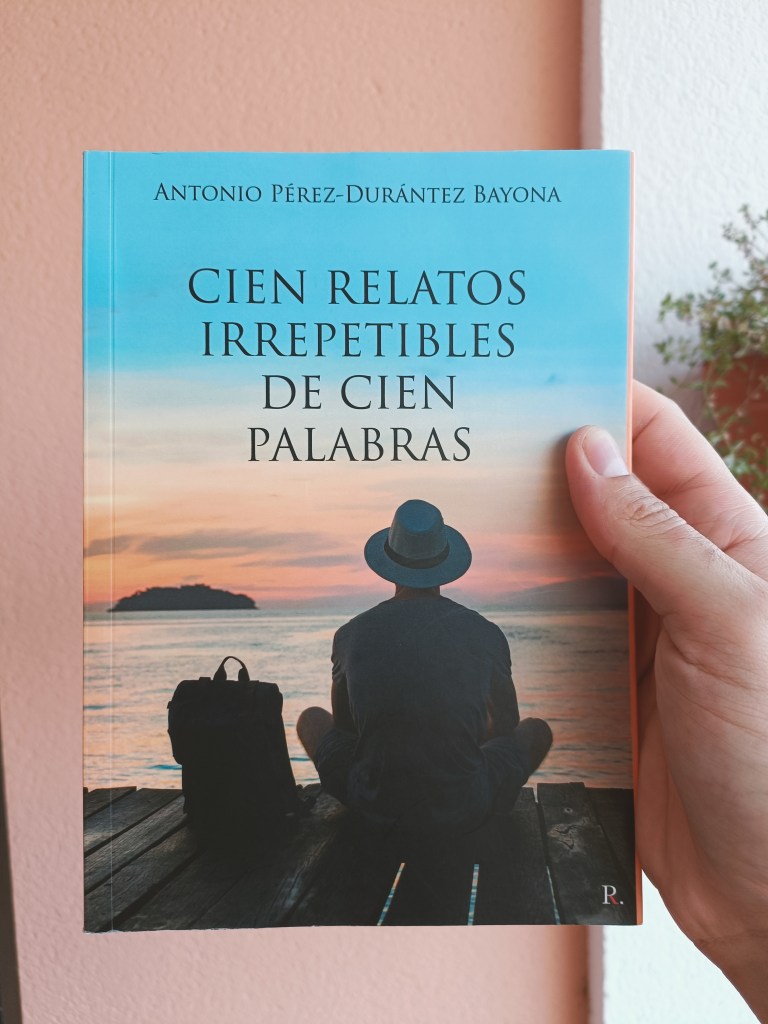
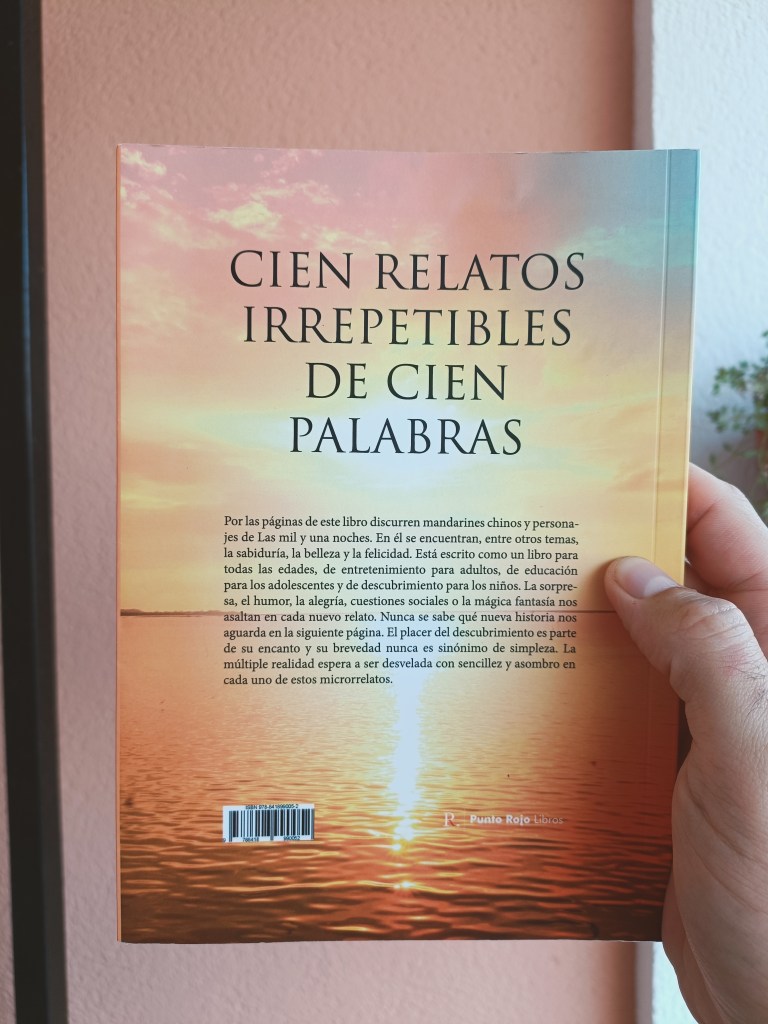
- Publication date: 2021
- Country Spain
- Pages: 116
- Reading date: September 2022
- Rating: 4/5
The author is Antonio Pérez-Durántez Bayona (Barcelona, Spain, 1973–). He holds a degree in Hispanic Philology from the University of Zaragoza and has worked as a Secondary School teacher of Spanish Language and Literature. His hobbies include reading and playing the piano. He has only recently begun his career as a writer, having previously published a couple of works in newspapers.
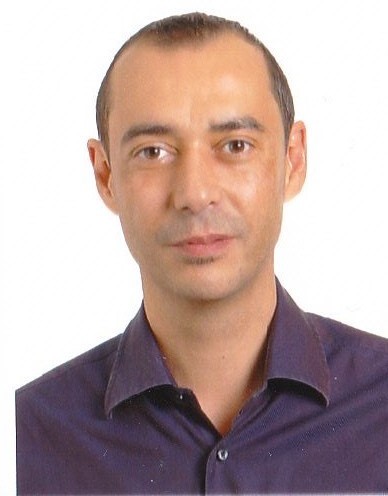
I came across this book by chance in Zaragoza and had the chance to meet the author and get a personal dedication from him. I must say that right from the start, Antonio conveyed his love of literature to me, and I found him to be a creative and intelligent person. Thank you very much for your book of micro-stories, Antonio; it was a real pleasure to read it.
His book contains one hundred micro-stories, as the title suggests, each consisting of exactly one hundred words. At first I thought this was simply a figure of speech, but I stopped to count the words in each micro-story and they do indeed add up to one hundred. To be honest, I found this an incredible feat, as I think it’s difficult to maintain that length in every story whilst ensuring they are well written. Nevertheless, the author succeeds in his endeavour. He uses condensation, ellipsis and economy of language to write stories within that word limit.
«EGOMANIA:
The fundamental premise for doing any work is to regard it as necessary to avoid boredom. The only thing that is impossible to bear is doing nothing.
By that, I do not mean being idle. During leisure time, one engages in activities. Doing nothing is, quite literally, shutting yourself away in a place and suppressing even the slightest desire to carry out any activity.
To achieve this, you need all your strength. You must be like a black hole that completely absorbs all energy and redirects it towards your own self-pity as a useless human being.
This is an unbearable state that can only lead to suicide. It is known by one name: ‘depression’.»
Antonio Pérez-Durántez Bayona

The micro-stories are all independent of one another, and the themes are varied, as is the tone of each one. Some are fantasy, humorous or satirical, whilst others are social commentaries or reflective pieces on happiness and everyday life. As they are so short, they are quick to read; nevertheless, it is a delight to pause and reflect on the depth of the message in some of them. Amongst its other strengths is the ability to craft a surprising or thought-provoking twist at the end using so few words.
«REALITY:
When asked what the truth was and what could be said about it, Hu-Zou replied: «The truth is nothing more than a correspondence, a match between the events as recounted and the events as they actually occurred.
When this match exists, we are speaking the truth. When it does not, we are lying.
Furthermore, as everyone has their own way of recounting events, we can say that there are as many truths as there are people to tell them.
There is no way to state a truth without it being believed.
Whilst the truth is manifold, the lie is but one: everything that is not true.»
Thus concluded Hu-Zou.»
Antonio Pérez-Durántez Bayona
I think about this challenge of limiting oneself to exactly one hundred words in each story, and I cannot help but sometimes feel that it is a constraint or an obligation. Perhaps this means that, in some of the micro-stories, length takes precedence over the story itself. Perhaps this plays in favour of certain stories and against others, as some ideas might require further development, whilst others might actually benefit from brevity.
«DISONANCE:
The city roars, making one’s head spin. Engines and tyres rumble on the tarmac. Drivers honk their horns impatiently. Sirens wail, deafening and alarming. Drills drone on relentlessly. Aeroplanes fly overhead with a thunderous roar. Trains rattle along, shrill. Crowds clatter on, tireless. Stadiums rumble, trembling. Protesters shout, indignant. Schoolchildren squeal, joyful. Children cry, untimely. Musicians play, spirited. Drums roll, stubborn. The bells chime, insistently. The balls bounce, wearily. The dogs bark, tenaciously. The cats meow in heat. The birds chirp, obstinately. The insects buzz, tirelessly. The wind howls, repetitively.
Beneath all this cacophony lies the silent stillness.»
Antonio Pérez-Durántez Bayona
In conclusion, reading this little book has been an enjoyable and stimulating experience. I enjoyed some of the micro-stories more than others – to each their own, as is obvious. Furthermore, I found the 100-word rule striking and a rather impressive exercise in ingenuity. On the one hand, this rule can stimulate the author’s creativity; on the other, it may perhaps constrain it too much. It would be interesting to discuss this question with the author.
Some reflections:
- Which is more difficult: writing a long story or ensuring that every word is essential?
- Can a micro-story leave the same impression as a novel running to hundreds of pages?
- How many words does a good story really need?
Type your e-mail address and click on subscribe to be notified of new content!
- Dewey
- Dewey Lee Más Libros
- One hundred unique stories in one hundred words
- Cien relatos irrepetibles de cien palabras
- Canciones del príncipe Vogelfrey
- Songs of Prince Vogelfrei
- A bestiary of prehistory
- Un bestiario de la prehistoria
- Los límites de mi lenguaje: Meditaciones sobre la depresión
- The limits of my language: Meditations on depression
Cambia el idioma a:



Which are the latest blog posts?