The Small-Town Library Cat Who Touched the World
This book tells the story of a cat who lived in a library in the United States.
This book can therefore be classified within the didactic genre in the form of memoirs and subclassified in the biography category, although it contains autobiographical elements.
This is a first edition published by the Suma de Letras imprint in 2009, which was jointly established by Grupo Santillana and Ediciones B in 2000. Later, in 2014, Santillana became part of Penguin Random House Publishing Group, and with it, Suma de Letras. This book is also available in English.
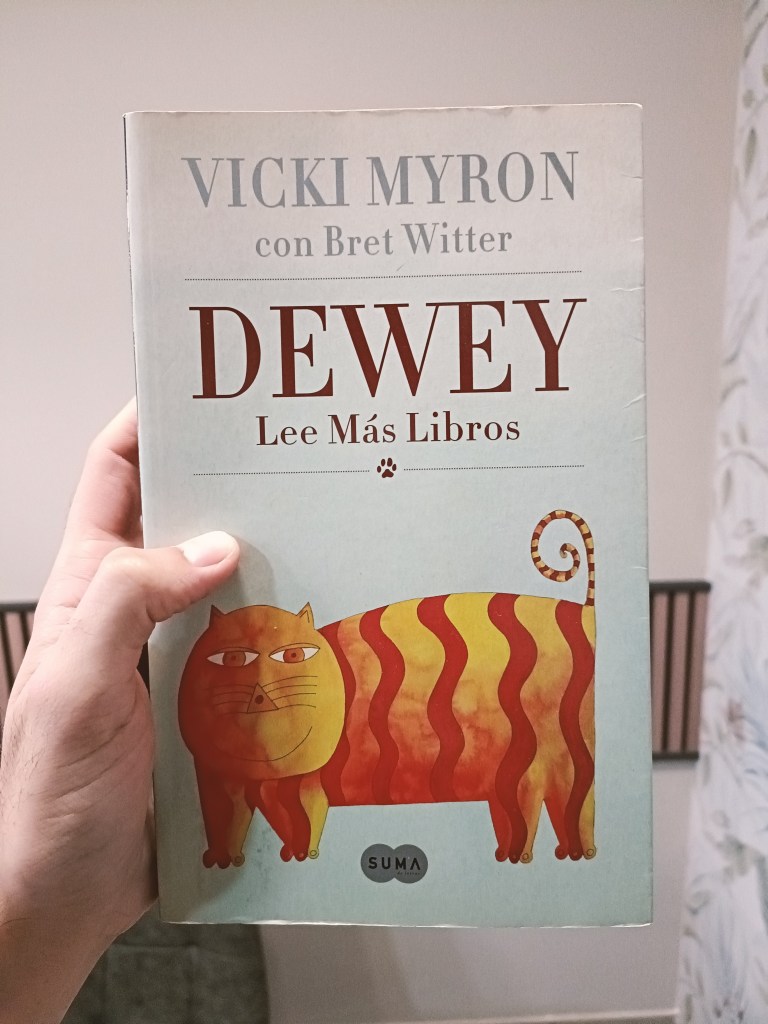
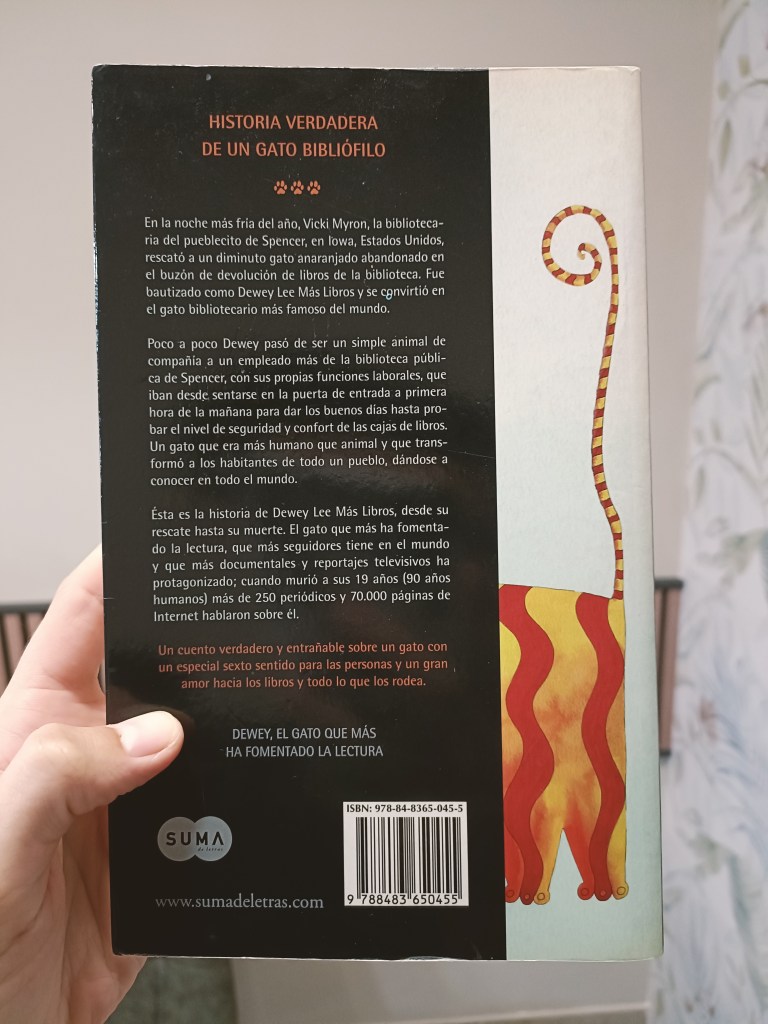
- Publication date: 2008
- Country: USA
- Pages: 296
- Reading date: February 2023
- Rating: 4/5
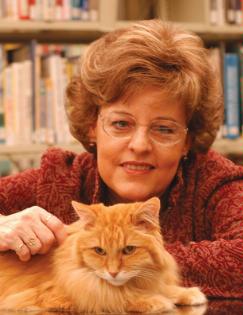
The author is Vicki Myron (Spencer, Iowa, USA, 1947–). She was an American librarian and writer. She graduated summa cum laude from Mankato State University (now Minnesota State University) and subsequently obtained a Master’s degree in Library Studies from Emporia State University. In 1982, she returned to her hometown to work at the public library, where she was appointed director in 1987. It was there that she met Dewey, the cat who is the subject of this biography. Myron retired in 2007 and wrote this story. She was assisted in the writing of the book by Bret Witter, who helped with the literary development of the work.
Other books published by her are:
- Dewey’s Nine Lives: The Legacy of the Small-Town Library Cat Who Inspired Millions (2010).
Within the list of other books published by the same author, those for which there is already a post in this blog are highlighted.
Click on it to read it!
I came across this book by chance in a second-hand bookshop in Zaragoza. The first thing that caught my eye was the cover, which features an orange cat, and the word ‘books’ in the title. Cats and books. Both of these elements were enough on their own to make me part with my money and buy this book.
At first glance, it is a book which tells the story of a cat called Dewey who lived in a library in the US, looked after by Vicki, the author of this story. In it, she recounts Dewey’s life, from the moment she first found him abandoned in the library’s book return box, right up until his death 19 years later. However, the book delves deeper and goes beyond simply recounting a series of events.
«I filled the sink in the staff lounge with hot water and checked the temperature with my elbow, without letting go of the kitten for a moment. It slid into the sink as if it were an ice cube. Jean found some shampoo in the arts-and-crafts cabinet, and I rubbed the little creature slowly and gently, almost as if I were petting it. And as the water turned grayer, the kitten’s fierce trembling gradually gave way to a soft purr. I smiled. It was a tough little cat. But also very young. When I finally lifted it out of the sink, it looked like a newborn: all eyes and ears standing out on a tiny head and an even smaller body. Wet, helpless, and meowing softly, calling for its mother».
Vicki Myron

The book is not merely the story of Dewey; it is more than just an animal biography. Through the story of Dewey’s life, the author reflects on her own life, hence the autobiographical elements, as she addresses her personal and family difficulties, her work, the town of Spencer… It could be said that the bond between Dewey, Vicki and the people of Spencer invites us to reflect on themes such as companionship, community, the role of libraries and the connection between humans and other animals.
I found it quite an enjoyable read, as it is a true story – simple and moving. As I’ve said, the cat ultimately serves as a common thread for exploring profound issues. I found the combination of genres within a single book particularly interesting: it is an animal biography, an autobiographical memoir and a chronicle of life in a small US town. Furthermore, the language in which the book is written is quite accessible.
«These parents, who were only stopping by for a moment, barely had time to pet Dewey. They worked exhausting days and had meals to prepare and houses to clean before going to bed. But their children spent hours with Dewey, had fun with him, and loved him. I never realized how much that meant, or how strong those bonds were, until I saw the mother of one of the boys crouch down next to the little animal.
“Thank you, Dewey,” she whispered, as she gently stroked his head.
I assumed she was thanking him for spending some time with her son, for filling what might otherwise have been a few uncomfortable and lonely hours for him.
She stood up and put her arm around her son. Then, as they walked out the door, I heard her ask the boy:
“How was Dewey today?”».
Vicki Myron
This may also be a point that not all readers will appreciate. There may be readers who were expecting a book focused exclusively on the story of Dewey the cat. Readers who find it repetitive that the author keeps emphasising Dewey’s impact on different people. However, to me this seems, on the contrary, to be one of the most beautiful aspects of the work. In my view, we are not islands. We are interconnected, and the life of any being, whatever the species, is interdependent with its environment and all other lives. Highlighting the role of an animal in the lives of so many people is moving, as it emphasises the honesty and vulnerability of each and every one of us, as well as the need for bonds of affection, whatever form they may take.
In particular, I must mention a part of the book where I felt this was written in a truly honest and raw way. This part dealt with Dewey’s death and the resulting feelings of loss, which the author uses to reflect on how we, as a society, experience grief and old age.
«They brought it up again. That Dewey didn’t look so good anymore. That Dewey was damaging the library’s image. I knew they meant well, that they wanted to find the best solution for everyone, but I couldn’t figure out what they were getting at. It was true—Dewey wasn’t as attractive as he used to be. Everyone gets older. Eighty-year-olds don’t look the same as twenty-year-olds, and that’s just the way it is. We live in a “use-and-throw-away” culture that pushes the elderly to the sidelines and tries not to look at them. They have wrinkles. They have age spots. They don’t walk well, and their hands shake. Their eyes are watery, or they drool when they eat, or they “burp in their pants” too much (a phrase Jodi used when she was two). And we don’t want to see any of that. Even the most capable older people—or those who devoted their entire lives to us—we want them out of sight and out of mind. But perhaps older people, and older cats, have something to teach us—if not about the world, then certainly about ourselves».
«My moments with Dewey were becoming increasingly rare. The staff had taken away his food and bowls while I was out, but I had to get rid of his toys. I had to clear out his shelf: the petroleum jelly for hairballs, the brush, the skein of red yarn he’d played with his whole life. I had to park the car and walk up to the library every morning without Dewey greeting me from the doorway. When the staff returned to the library after seeing Dewey for the last time, the space heater in front of which he would settle down every day wasn’t working. That very morning, Dewey had been right next to it, and it had been working just fine. It was as if his death had also taken away its reason for being. Can a broken appliance break your heart? Six weeks went by without me even considering repairing that heater».
Vicki Myron
In this way, Vicki Myron does not present Dewey’s death solely as the personal loss of her cat. He had lived in the library for 19 years and had formed bonds with staff, visitors and the residents of Spencer. Because of this, his absence has an impact on the whole community. Understanding this helps us to see grief as an intersubjective experience, not merely as a private one. Shared memories and rituals enable the community to rebuild itself following the loss of one of its members. And animals are also part of the community; therefore, they are members too. If you are interested in this topic of grief as an intersubjective experience, I recommend the essay Death in common by Ana Carrasco-Conde, in which she discusses the subject at length.
In conclusion, Dewey’s story has not only introduced me to the life of this librarian cat, but has also given me an insight into everyday life in a small-town community in the US, revealed aspects of Vicki Myron’s life – a life that was by no means easy – and prompted me to reflect on the bond between humans and non-human animals. The book’s conclusion offers an interesting analysis of loss and its impact on the community. It has been an enlightening and serene read.
«That’s life. We all end up between the tractor blades from time to time. We all take a few hits, and we all get cut now and then. The lucky ones come out of it with a few scrapes, a little blood, and nothing more. The important thing is to have someone to pick you up, hold you close, and tell you that everything will be all right.
For years, I did this for Dewey. That was the story I had to tell. And that’s what I’ve done. When Dewey was hurt, freezing, and whimpering, I was there. I hugged him. I made sure everything was okay.
But this is only a tiny piece of the truth. The truth is that, all these years—the bad days, the good days, and all the forgotten days that make up the pages of the real book of our lives—Dewey was hugging me.
And he’s still hugging me now. So thank you, Dewey. Thank you. Wherever you are».
Vicki Myron
Some reflections:
- To what extent can animals help us get through times of loneliness, illness or hardship?
- Can a library be more than just a place where books are kept and lent out? What does a place need to truly become a community?
- If we are who we are partly because of our connections with others, what part of them remains within us when they die?
Type your e-mail address and click on subscribe to be notified of new content!
- Dewey
- Dewey Lee Más Libros
- One hundred unique stories in one hundred words
- Cien relatos irrepetibles de cien palabras
- Canciones del príncipe Vogelfrey
- Songs of Prince Vogelfrei
- A bestiary of prehistory
- Un bestiario de la prehistoria
- Los límites de mi lenguaje: Meditaciones sobre la depresión
- The limits of my language: Meditations on depression
Cambia el idioma a:



Which are the latest blog posts?