This book is a philosophical and reflective essay on the nature of love, falling in love, attraction between people, and the psychological mechanisms at stake in romantic relationships.
As such, this book can be classified within the didactic genre, in the form of an essay, and further subclassified among those belonging to the field of Contemporary Western Philosophy.
This is the 18th edition, published in 2019 by Editorial Edaf, a Spanish publishing house founded in Madrid in 1959 and specialising in the publication of popular science works, philosophy, psychology, spirituality, the humanities and literary classics. Its catalogue is characterised by bringing texts on thought and knowledge—by both classical and contemporary authors—to the general public. This book is available in English.
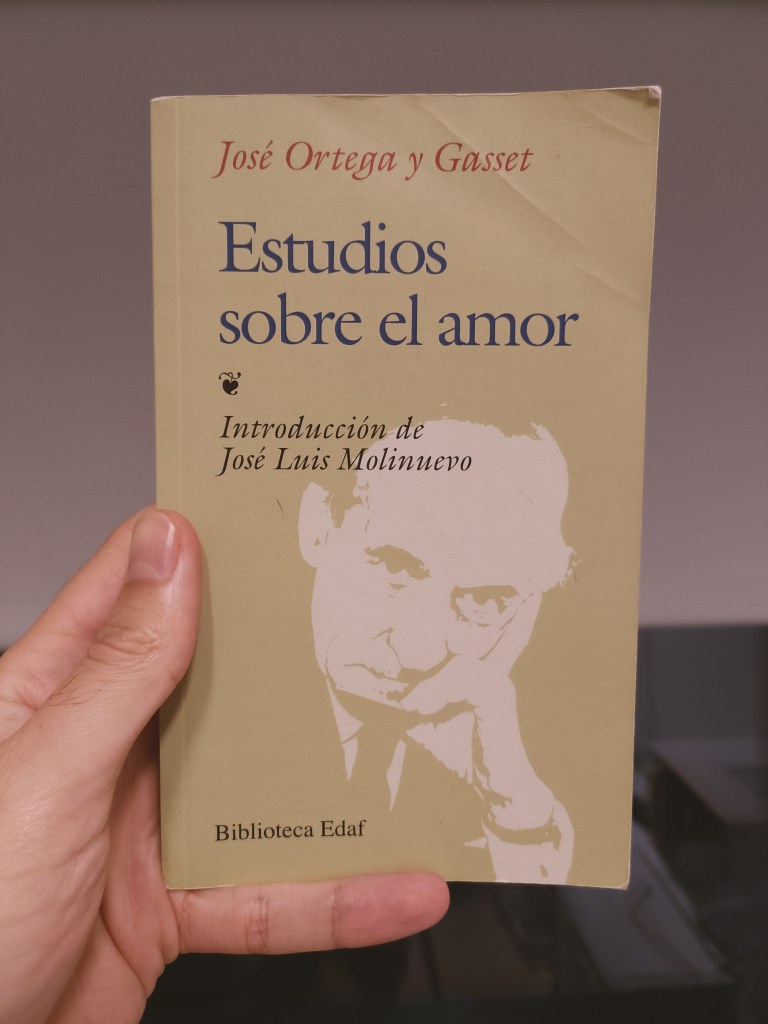
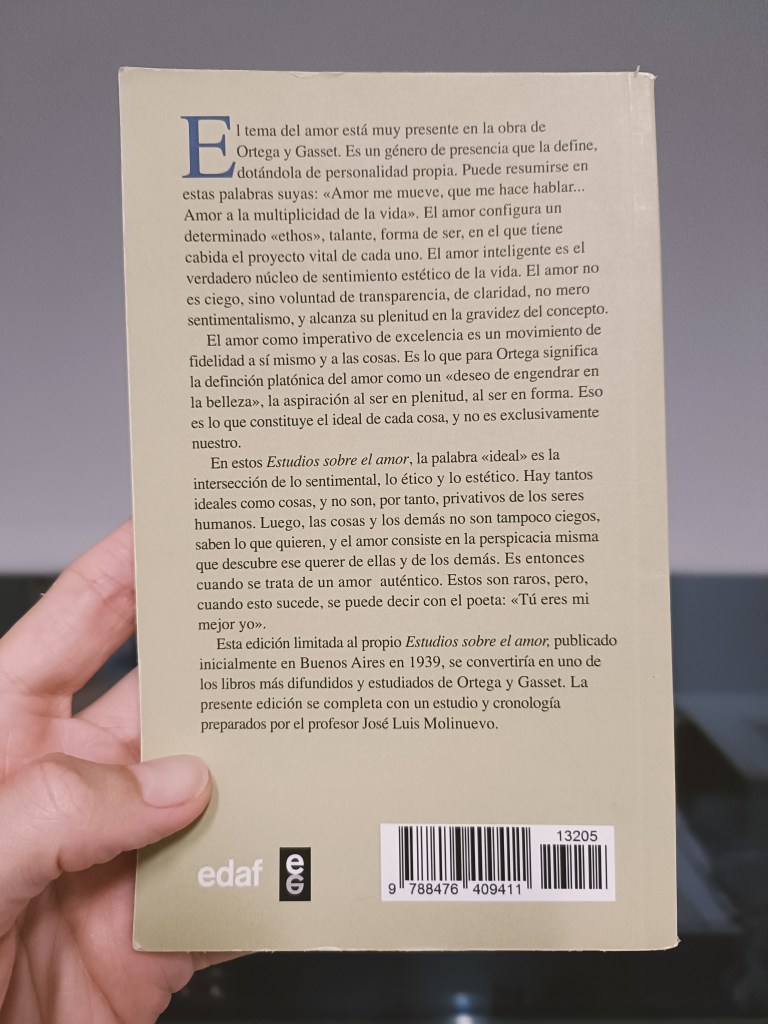
- Publication date: 1939
- Country: Argentina
- Pages: 184
- Reading date: June 2019
- Rating: 2/5
Regarding the author of the book, José Ortega y Gasset (Madrid, Spain, 1883–1955) was a Spanish philosopher, essayist, journalist and university lecturer, regarded as one of the most influential thinkers in 20th-century Spanish philosophy. He studied Philosophy and Arts at the University of Deusto and at the Central University of Madrid, where he was awarded his doctorate in 1904, and furthered his studies at various German universities. In 1910, he was appointed to the Chair of Metaphysics at the Central University of Madrid. He founded the Revista de Occidente in 1923 and developed a philosophy centred on raciovitalism and perspectivism, through which he reflected on human life, culture, society and history. He died at the age of 72 from stomach cancer.
Other books published by him are:
Within the list of other books published by the same author, those for which there is already a post in this blog are highlighted.
Click on it to read it!
I came across this book quite by chance whilst browsing in a second-hand bookshop in Madrid called Tuuulibrería. I’d already read The Revolt of the Masses whilst I was in my second year of Bachillerato, and I’d found José Ortega y Gasset’s reflections interesting at the time. So, I bought this essay of his, entitled On Love, from that bookshop and read it as soon as I could.
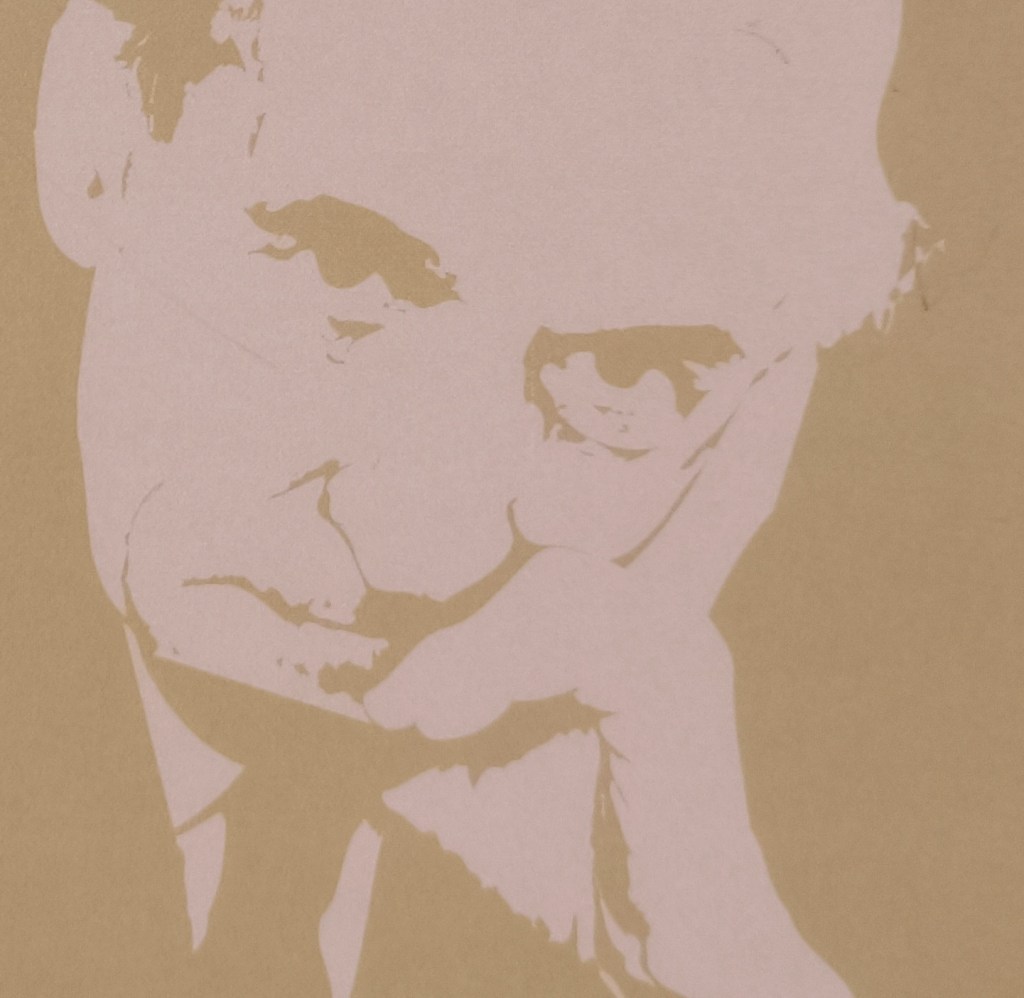
«To love is a ceaseless revitalisation, the intentional creation and preservation of the beloved«.
«Love is heart to heart: harmony; hate is discord, metaphysical dissension, an absolute separation from that which is hated».
«Desire dies automatically once it is fulfilled; it fades away when satisfied. Love, on the other hand, is eternally unsatisfied».
José Ortega y Gasset
The book presents a series of reflections in which the author analyses the nature of love and falling in love from different perspectives. In his analysis, he seeks to understand what it means to love, how attraction to another person arises, and what distinguishes love from other feelings. In his method of analysis, he combines philosophical reflection with psychological observations and literary references.
Ortega y Gasset combines a rational analysis of the subject without neglecting romanticism. By this I mean that he attempts to explain love without stripping it of its emotional dimension, whilst acknowledging its complexity. Furthermore, he draws an interesting distinction between falling in love and love itself, questioning whether such an initial fascination with another person necessarily amounts to genuine love. In his arguments, the author engages in dialogue with other thinkers and writers, such as Stendhal.
The Spanish thinker puts forward ideas which, as I read, prompted me to reflect on and reconsider my own experiences of love and romance. For this reason, I believe it is an essay that stimulates critical thinking, although I do not necessarily agree with the conclusions reached by the author.
«Falling in love is a state of mental misery in which the life of our consciousness becomes constricted, impoverished and paralysed”.
José Ortega y Gasset
Among the most questionable aspects of the work are the author’s sexism and outdated views on gender. In certain passages, the writer draws distinctions between men and women which reflect an essentialist view of gender strongly shaped by the era and culture. He thus makes rather reductionist generalisations about femininity, masculinity and choice in love, which are difficult to reconcile with a more contemporary perspective. The fact that this framework of thought can be contextualised historically does not preclude questioning his ideas.
Furthermore, I got the impression that, on numerous occasions, Ortega y Gasset tends to present personal intuitions and interpretations as universal truths, thereby diminishing the sharpness of his analysis. Furthermore, the author’s conception of romantic relationships is limited, as it is developed primarily from a heterosexual perspective and within the social models of the time, as I mentioned earlier. In my view, this reduces his ability to represent the diversity of emotional experiences that we recognise today.
«It is futile to oppose the essential law – not merely a historical, transitory or empirical one – which makes of the man a substantially public being and of the woman a private being. Any attempt to subvert that destiny is doomed to failure. It is no coincidence that the ultimate annihilation of the feminine norm consists in a woman becoming a ‘public woman’, and that the fulfilment of the masculine mission—the highest form of male existence—is the ‘public man’”.
«A woman’s strength lies not in knowing, but in feeling. To know things is to have concepts and definitions for them, and this is a man’s domain. A woman does not know; she has not defined that model of masculinity for herself, but the enthusiasm and aversion she feels in her dealings with men amount, for her, to the practical discovery of that ideal burden which, unbeknownst to her, she carried in her heart”.
José Ortega y Gasset
In conclusion, in this essay Ortega y Gasset offers original and thought-provoking reflections on falling in love, attraction and human relationships that piqued my interest. I believe he manages, to some extent, to reconcile a romantic view of love with a rational and psychological analysis. However, some of his ideas are too categorical and reveal a sexist and outdated view of relationships between men and women. Although these must be viewed in the context of the writer’s era, they can still be called into question. All in all, I found it an intellectually stimulating read, with ideas that invite reflection, but also with many prejudices and notions that have become outdated due to social changes and the development of psychology as a science.
In my view, there is thus an interesting contradiction here, namely that whilst the author demonstrates great sensitivity in analysing the nuances of romantic love, that same sensitivity does not usually extend to his understanding of the individual differences between men and women.
«A love that is complete, one that has sprung from the very core of a person, cannot plausibly die. It is forever embedded in the sensitive soul. Circumstances – for example, distance – may prevent it from receiving the nourishment it needs, and so that love will diminish in intensity, becoming a faint sentimental thread, a brief vein of emotion that will continue to flow beneath the surface of consciousness. But it will not die: its emotional essence remains intact. At that deepest level, the person who has loved continues to feel utterly bound to the beloved. Chance may carry them hither and thither in physical and social space. It does not matter: they will continue to be with the one they love. This is the supreme sign of true love: being alongside the beloved, in a contact and closeness deeper than mere physical proximity. It is a vital being-with the other. The most precise term—though overly technical—would be: an ontological being-with the beloved, faithful to the beloved’s destiny, whatever that may be».
José Ortega y Gasset
Some reflections:
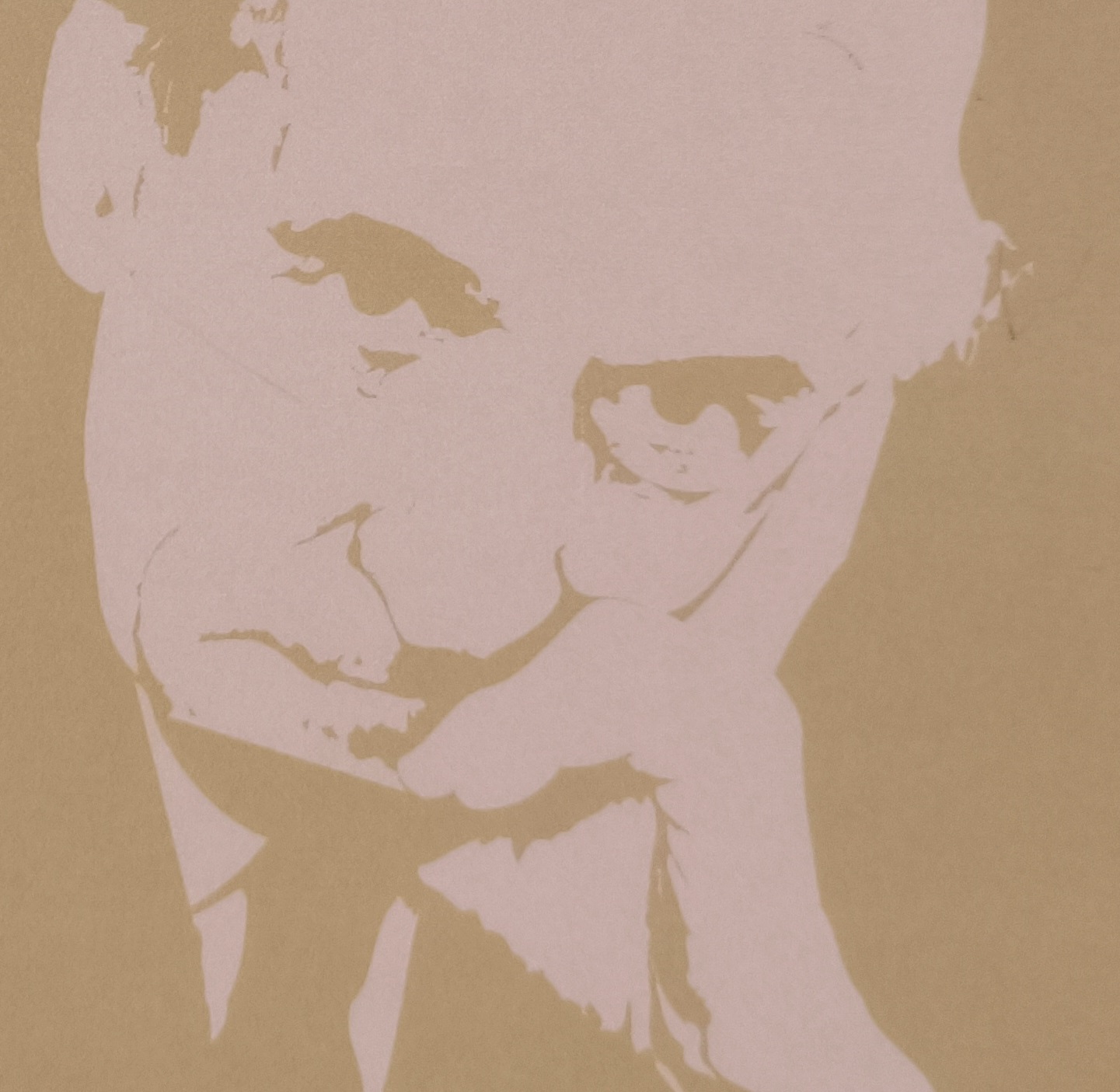
- Is falling in love a form of love or, as Ortega suggests, a kind of obsession that limits our perception of reality?
- Can true love ever fade away, or, as Ortega argues, does it somehow remain within us forever?
- To what extent is our understanding of love still shaped by gender roles?
Type your e-mail address and click on subscribe to be notified of new content!
- In Clothes Called Fat
- Gorda
- On Love: Aspects of a Single Theme
- Estudios sobre el amor
- The Incest Diary
- Diario de un incesto
- Pau, el hombre que mira lejos
- Pau, the Man Who Gazes into the Distance
- Orlando
- Orlando
Cambia el idioma a:









Which are the latest blog posts?