This book is a chronological collection of letters from the Dutch artist Vincent van Gogh to his brother Theo.
Thus, this book can be classified within the didactic genre under the form of memoirs and subclassified among those in the form of letters.
This is a 2020 eighth reprint of the second edition released by Alianza Editorial S.A. in 2012, which is a Spanish publishing house founded in 1966 during the Franco dictatorship in order to promote debate and spread knowledge. This book is published in English too.
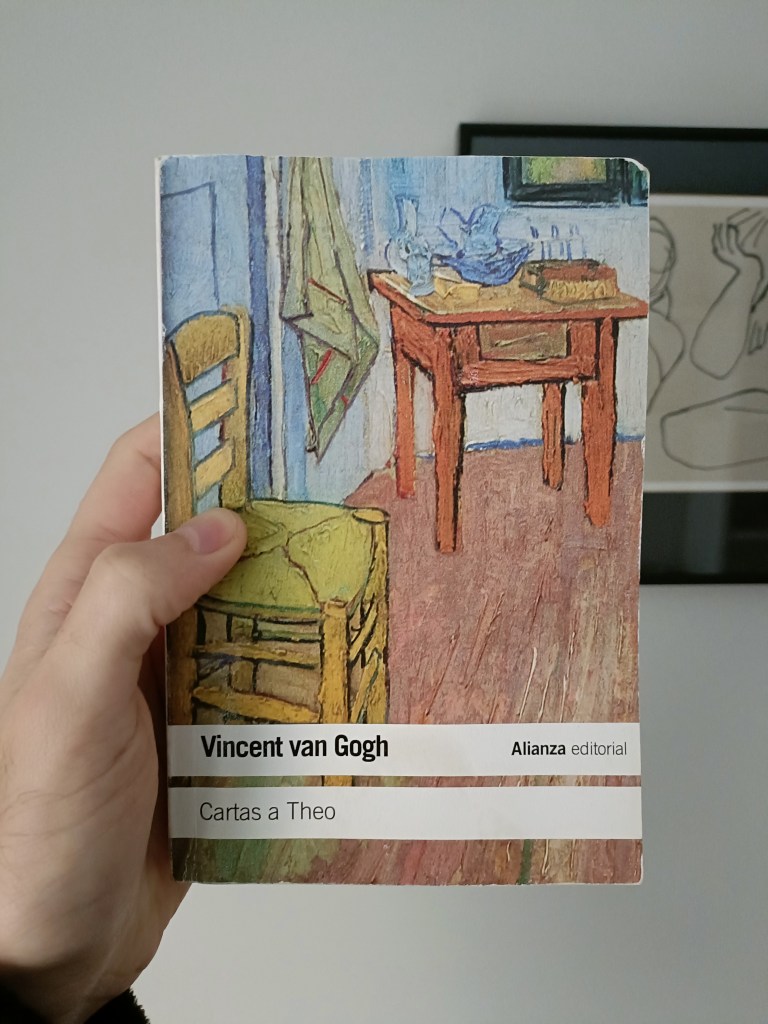
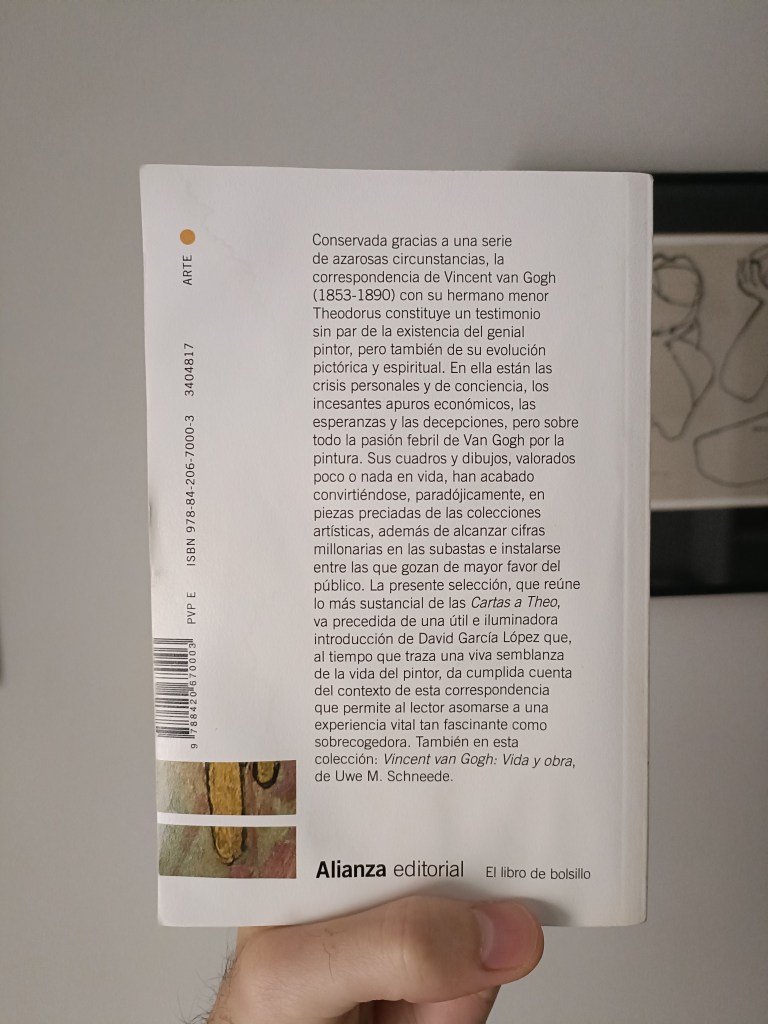
- Publication date: 1914
- Country: Netherlands
- Pages: 496
- Reading date: December 2021
- Rating: 4/5
The author is Vincent Willem van Gogh (Zundert, Netherlands, 1853-Auvers-sur-Oise, France, 1890). He was a Dutch painter and one of the greatest exponents of Post-Impressionism. From an early age he had a keen interest in drawing, although he worked at various jobs before devoting all his energies to his artistic facet at the age of 27. It was only after his death (whether suicide or accident is unclear) that his work was widely acclaimed and his paintings fetched millions at auction. His influence on 20th and 21st century art endures.
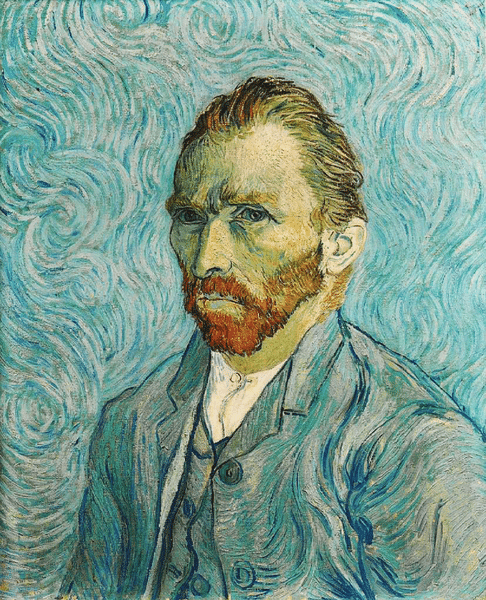
I have always heard the name of the painter Vincent van Gogh and admired his most emblematic paintings. However, it was not until 2020 that my interest in him increased enormously. In that year I was able to go to an exhibition in Madrid called Van Gogh Alive and then I watched the film Loving Vincent, which remains among my favourite films forever. I found its soundtrack highly inspiring, especially Lianne La Havas’ version of the song «Starry Starry Night».
My interest in the Dutch painter’s art was already obvious, but I had not yet planned to read his letters. It was then that I met a person who has become more special in my life every day. She is a great lover of Van Gogh’s art and, above all, of the epistolary genre of literature. It was she who urged me to read people’s letters, their biographies and autobiographies in order to gain insight into their works. I have to say that it was a great decision to open myself more to this genre, so I am very grateful for her words.

«I still can find no better definition of the word art than this, “L’art c’est l’homme ajouté à la nature” [art is man added to nature] – nature, reality, truth, but with a significance, a conception, a character, which the artist brings out in it, and to which he gives expression, “qu’il dégage,” which he disentangles, sets free and interprets».
Van Gogh
During his wandering life, Vincent van Gogh, considered one of the greatest painters in history, wrote numerous letters. Most of them were to his brother, with whom he corresponded intensely. Not all the letters were dated, but those which were, were published in chronological order.
In the present book, which brings together the letters to his brother Theo, we learn about the hard and suffering life of the Dutch artist, who created great beauty and genius despite his needs and his illness.
«If we but try to live uprightly, then we shall be all right, even though we shall inevitably experience true sorrow and genuine disappointments, and also probably make real mistakes and do wrong things, but it’s certainly true that it is better to be fervent in spirit, even if one accordingly makes more mistakes, than narrow-minded and overly cautious. It is good to love as much as one can, for therein lies true strength, and he who loves much does much and is capable of much, and that which is done with love is well done».
Van Gogh
In the letters he touches on different subjects. Some are more art-related, sharing his pictorial development, his study of colour, his vision of art and of being an artist, as well as his ideas about the work of other painters he admires. He also tells his brother about his love of reading, especially literary works of French realism and naturalism.
Other letters are mainly concerned with more personal themes and revelations. He speaks of landscapes, nature, farm workers, the stars, the places where he stays and their people…. All with a touching sincerity, impregnated with an existentialism that reflects on his place in the world and the loneliness it generates in him.
«In the springtime a bird in a cage knows very well that there’s something he’d be good for; he feels very clearly that there’s something to be done but he can’t do it; what it is he can’t clearly remember, and he has vague ideas and says to himself, «the others are building their nests and making their little ones and raising the brood«, and he bangs his head against the bars of his cage. And then the cage stays there and the bird is mad with suffering. (…) You know, what makes the prison disappear is every deep, serious attachment. (…) And the prison is sometimes called prejudice, misunderstanding, fatal ignorance of this or that, mistrust, false shame».
Van Gogh
All the beautiful things Vincent talks about in his letters to Theo contrast with his life on the edge of destitution, starving and living on the little money his brother sent him. Some of the letters hint at the painter’s life of poverty, and how this was a factor in his deteriorating health.
«But when my ten francs ran out I tried to bivouac in the open air the last 3 nights, once in an abandoned carriage which was completely white with hoarfrost the next morning, not the best accommodation, once in a pile of faggots; and once, and that was a slight improvement, in a haystack, that had been opened up, where I succeeded in making myself a slightly more comfortable little hideaway, though the drizzle did not exactly add to my enjoyment. Well, and yet it was in these depths of misery that I felt my energy revive and I said to myself, I shall get over it somehow, I shall set to work again with my pencil, which I had cast aside in my deep dejection, and I shall draw again (…)».
«After the crisis I went through when I came here, I can no longer make plans or anything else; I’m definitely better now, but hope, the desire to achieve, is broken and I work from necessity, so as not to suffer so much mentally, to distract myself».
Van Gogh
It is a tragic paradox that Vincent was unable to sell his paintings during his lifetime, but after his death he became a legend and his work a unique pictorial landmark.
It is clear that he would not have been able to paint and realise his passion without the support of his brother Theo. They both loved each other deeply, and the guilt and anguish, as well as Vincent’s deep gratitude and love for him, do not leave the reader of these letters indifferent either.
«I myself realize the necessity to produce even to the extent of being morally crushed and physically drained by it, just because after all I have no other means of ever getting back what we have spent. I cannot help it that my pictures do not sell. The day will come when people will see that they are worth more than the price of the paint and my own living, very meager after all, that is put into them. I have no other desire nor any other interest as to money or finance, than primarily to have no debts. But my dear boy, my debt is so great that when I have paid it, when all the same I hope to succeed in doing, the pains of producing pictures will have taken my whole life from me, and it will seem to me then that I have not lived».
Van Gogh
As I read the letters, I could see how Vincent’s difficulties and health became more and more unstable, and how he revealed even more of his inner world to his brother. In the course of the letters he wrote to him, the painter went from joy and enthusiasm for painting to anguish and psychological suffering. He had to be admitted to psychiatric sanatoriums, which he also discusses in his letters, as well as the medical judgments and his coexistence with other patients.
«And temporarily I wish to remain shut up as much for my own peace of mind as for other people’s. What comforts me a little is that I am beginning to consider madness as a disease like any other and accept the thing as such, whereas during the crises themselves I thought that everything I imagined was real».
«As far as I know the doctor here is inclined to consider what I’ve had as an attack of an epileptic nature».
«Phew – the reaper is finished, I think it will be one that you’ll place in your home – it’s an image of death as the great book of nature speaks to us about it – but what I sought is the ‘almost smiling’. It’s all yellow except for a line of violet hills – a pale, blond yellow. I myself find that funny, that I saw it like that through the iron bars of a cell».
Van Gogh
After reading Dear Theo, I got to know more about the person behind the paintings I already liked so much. It is interesting to delve deeper into the mind and life of Vincent Van Gogh. Thanks to the letters he wrote to his brother Theo, we can learn about his thoughts, his influences, his concerns and above all, his pain and his gaze on eternity. His love for his brother and his love for painting and the vibrant colours of reality is touching. Some of the letters, especially towards the beginning of this collection, were a bit denser for me due to my lack of knowledge of the subject because they speak more of pictorial art than of his inner world as an artist, but it was still a worthwhile read. It has made me more curious about his work and his life circumstances.
It is a recommendable book for all those interested in the history of art, or specifically in the life and person of Vincent.
«In short, I want to reach the point where people say of my work, that man feels deeply and that man feels subtly. Despite my so-called coarseness — you understand — perhaps precisely because of it. It seems pretentious to talk like this now, but that’s why I want to push on. What am I in the eyes of most people? A nonentity or an oddity or a disagreeable person — someone who has and will have no position in society, in short a little lower than the lowest. Very well — assuming that everything is indeed like that, then through my work I’d like to show what there is in the heart of such an oddity, such a nobody. This is my ambition, which is based less on resentment than on love in spite of everything, based more on a feeling of serenity than on passion. Even though I’m often in a mess, inside me there’s still a calm, pure harmony and music. In the poorest little house, in the filthiest corner, I see paintings or drawings. And my mind turns in that direction as if with an irresistible urge».
Van Gogh
Some reflections:

- What would you say to Van Gogh if you could have a conversation with him?
- Do you identify with any of his work?
- What is your favourite painting by the artist and do you think he is the greatest painter in history?
Type your e-mail address and click on subscribe to be notified of new content!
- Dewey
- Dewey Lee Más Libros
- One hundred unique stories in one hundred words
- Cien relatos irrepetibles de cien palabras
- Canciones del príncipe Vogelfrey
- Songs of Prince Vogelfrei
- A bestiary of prehistory
- Un bestiario de la prehistoria
- Los límites de mi lenguaje: Meditaciones sobre la depresión
- The limits of my language: Meditations on depression
Cambia el idioma a:



Which are the latest blog posts?