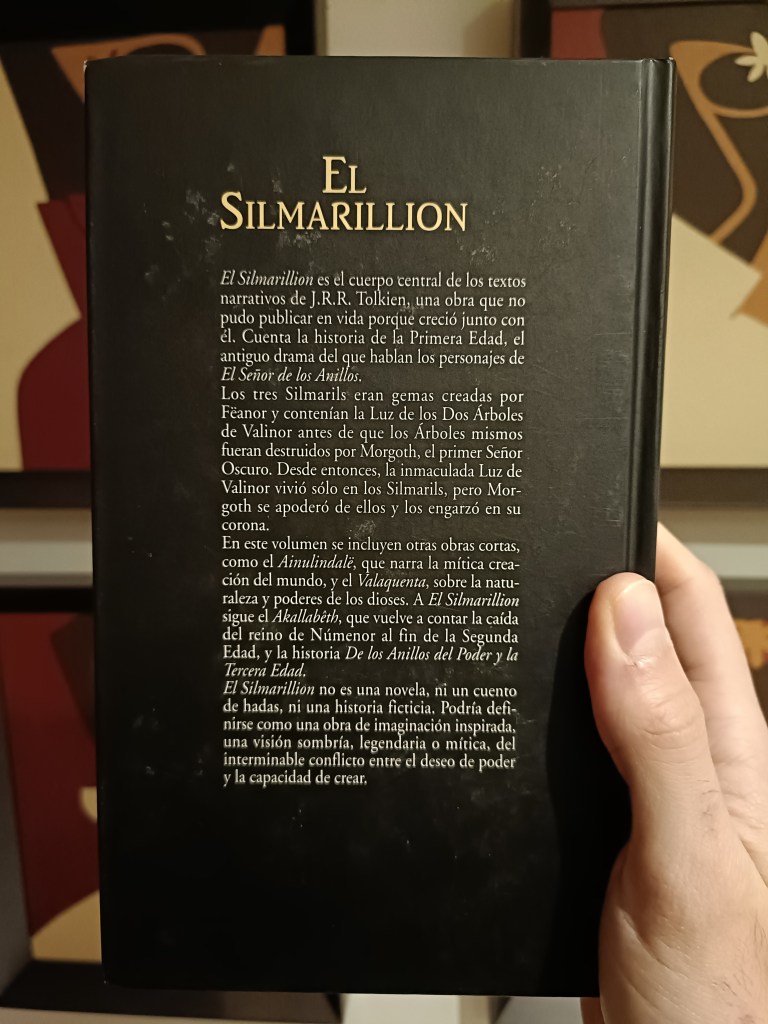
This book brings together several stories and myths from J.R.R. Tolkien’s legendarium, which, when grouped together, constitute the core of his entire oeuvre.
Thus, this book can be classified within the narrative genre in the form of an epic poem and subclassified within categories such as epic fantasy.
This is an edition distributed by the publishing house Planeta deAgostini in collaboration with Ediciones Minotauro in 2002, which is a Spanish publishing house founded in 1955 and which is a reference in the publication of literary works of science fiction, horror and fantasy in Spanish. It also publishes the annual Premio Minotauro. This book is available in English.
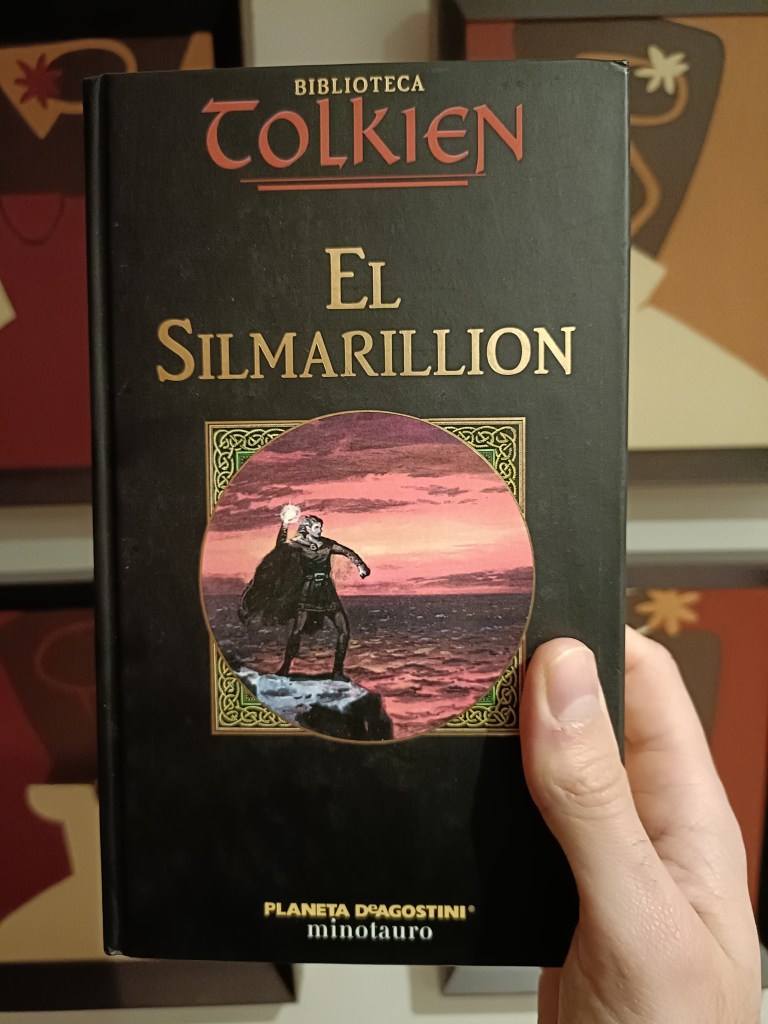
- Publication date: 1977
- Country: United Kingdom
- Pages: 496
- Reading date: September 2022
- Rating: 5/5
The author is John Ronald Reuel Tolkien (Bloemfontein, Orange Free State, 1892-Bournemouth, United Kingdom, 1973). He was a British writer, poet, philologist, linguist and university professor born in The Orange Free State, now part of South Africa. For some years he held a chair at Oxford University teaching Anglo-Saxon and later became Professor of English Language and Literature at Merton. He was a member of the literary discussion group known as the Inklings. He died at the age of 81 of peptic ulcer.
Some of his best known books are:
- The Hobbit (1937)
- The Lord of the Rings (1954)
- Letters from Father Christmas (1976) (posthumous publication)

Within the list of other books published by the same author, those for which there is already a post in this blog are highlighted.
Click on it to read it!
For as long as I can remember hearing about Tolkien’s work, The Silmarillion has been described to me as a difficult book to read, dense, but still worth getting into. This certainly generated respect in me, as well as uncertainty about reading it, as I couldn’t see the time to do it and I was looking forward to it at the same time.
I had already seen the film adaptations of The Hobbit and The Lord of the Rings novels when I started reading them. In all the reading guides for Tolkien’s work, I found it indicated to read those novels before trying The Silmarillion. So I started with that part of the British writer’s work and enjoyed it.
Later, after years of hearing about The Silmarillion, I finally started to get in touch with this important work of Tolkien’s Legendarium.
“And thus it came to pass that the Silmarils found their long homes: one in the airs of heaven, and one in the fires of the heart of the world, and one in the deep waters».
J.R.R. Tolkien

Tolkien wrote The Silmarillion as a set of stories set in the fantasy world he created, called Arda, of which Middle-earth (the setting of The Hobbit and The Lord of the Rings) is a part.
The stories in this work are independent, but strongly related to each other, despite being far apart in time and space. For the sake of structure and ease of understanding, the author divided the book into 5 parts:
- The Ainulindalë, which describes the process of creating this fantastic universe. This part is probably closer to the literary genre of mythopoeia.
- The Valaquenta, which tells little by little how the first Dark Lord Melkor arises from beings called Valar.
- The Quenta Silmarillion, which explains the events following the creation of three gems called Silmarils. Stories of elves, men and dwarves revolve around these gems. There are multiple confrontations between good and evil set in the First Age.
- The Akallabêth, which tells of the rise and fall of the Kingdom of Númenor, and tells of its descendants called the Dúnedain. This takes place in the Second Age.
- The History of the Rings of Power and the Third Age, in which the creation of these rings and the forging of the One Ring are explained, together with the wars and conflicts that occurred with it and its loss into oblivion. It ends just before the events narrated in The Hobbit and The Lord of the Rings.
«There was Eru, the One, who in Arda is called Ilúvatar; and he made first the Ainur, the Holy Ones, that were the offspring of his thought, and they were with him before aught else was made. And he spoke to them, propounding to them themes of music; and they sang before him, and he was glad. For a long while they sang only each alone, or but few together, while the rest hearkened; for each comprehended only that part of the mind of Ilúvatar from which he came, and in the understanding of their brethren they grew but slowly. Yet ever as they listened they came to deeper understanding, and increased in unison and harmony«.
J.R.R. Tolkien
During the reading I felt quite immersed in the book and the stories it told. At no point did I find it a dense read, but rather it got me so involved in the plot that I couldn’t get enough of it. The prose is beautifully poetic, and the epic tone of the narrative is really spot on. If I had to name one difficulty I had during the reading it would be not getting lost among so many character names and knowing how to mentally sort out and relate the number of events narrated in this set of epic fantasy stories.
Tolkien had many creative ups and downs which made the project of this work a slow process with many versions, which means that its structure is somewhat unfinished and that there are parts better closed than others, as well as differences in the rhythm of the events between them. The Silmarillion was published posthumously by Tolkien’s son Christopher, who was involved in the selection and some of the writing of the texts. Four years would pass between the author’s death and the publication of this book.
«This was the beginning of that people that in the Grey-elven speech are called the Dúnedain: the Númenóreans, Kings among Men. But they did not thus escape from the doom of death that Ilúvatar had set upon all Mankind, and they were mortal still, though their years were long, and they knew no sickness, ere the shadow fell upon them. Therefore they grew wise and glorious, and in all things more like to the Firstborn than any other of the kindreds of Men; and they were tall, taller than the tallest of the sons of Middle-earth; and the light of their eyes was like the bright stars».
J.R.R. Tolkien
In conclusion, Tolkien’s mastery of fantasy world-building has left me in awe. His stories that constitute a great epic fantasy epic poem, his creation myths, his creation of languages in said fantastic universe, as well as genealogical trees, geography and the richness of his characters and beings so far exceeds my expectations and leaves me with such a good taste in my mouth that I want to continue reading more of his works and analyses of it.
On the other hand, I would recommend reading this book if you have previously read something by the author and liked it. And to conclude, I would just like to point out that it may be necessary to read it carefully and to consult summaries, explanations or read it more than once to better understand the relationships between the different events and the names of the many characters appearing, given the distances in space and time between them.
«But Morgoth himself the Valar thrust through the Door of Night beyond the Walls of the World, into the Timeless Void; and a guard is set forever on those walls, and Eärendil keeps watch upon the ramparts of the sky. Yet the lies that Melkor, the mighty and accursed, Morgoth Bauglir, the Power of Terror and of Hate, sowed in the hearts of Elves and Men are a seed that does not die and cannot be destroyed; and ever and anon it sprouts anew, and will bear dark fruit even unto the latest days«.
J.R.R. Tolkien
Some reflections:
- What do you think about the fact that the epic poetry genre is still alive today?
- Did you know about mythopoeia?
- Does it attract you that a fantasy author invests so much dedication in world building, or does it make you apprehensive about delving into his or her work?
Type your e-mail address and click on subscribe to be notified of new content!
- I overcame the anorexia
- Yo vencí la anorexia
- Pensando en ellos
- Thinking about them
- Saldremos de esta: Guía de salud mental para el entorno de la persona en crisis
- We will get over this: A mental health guide for the environment of the person in crisis
- Traces of Madness: A Graphic Memoir
- Desmesura: Una historia cotidiana de locura en la ciudad
- When I sing, mountains dance
- Canto yo y la montaña baila
Cambia el idioma a:

 arquerociego
Which are the latest blog posts?