This book is the result of a compilation of scientific papers or essays on group therapy in different areas of mental health.
Thus, this book can be classified within the didactic genre in the form of a set of essays or scientific papers and subclassified among those in the field of Psychology.
This is a single edition published by Editorial Grupo 5, which is a Spanish publishing house that publishes books for the education and training of professionals working in the field of social and health services. This book has not been translated into English.
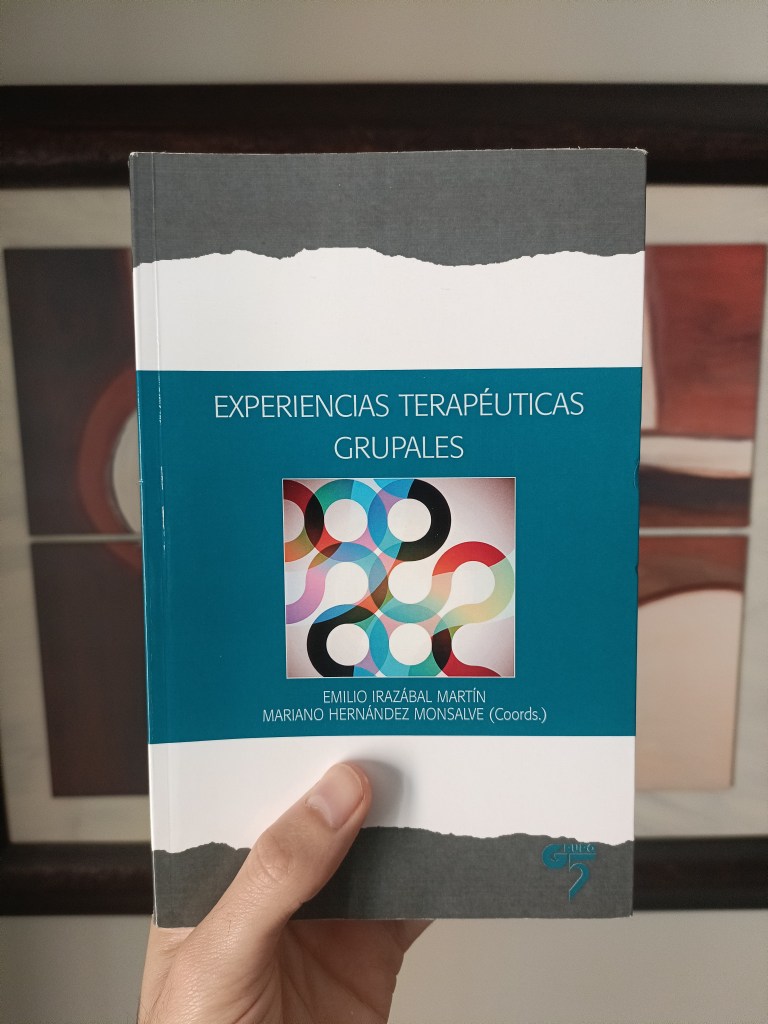
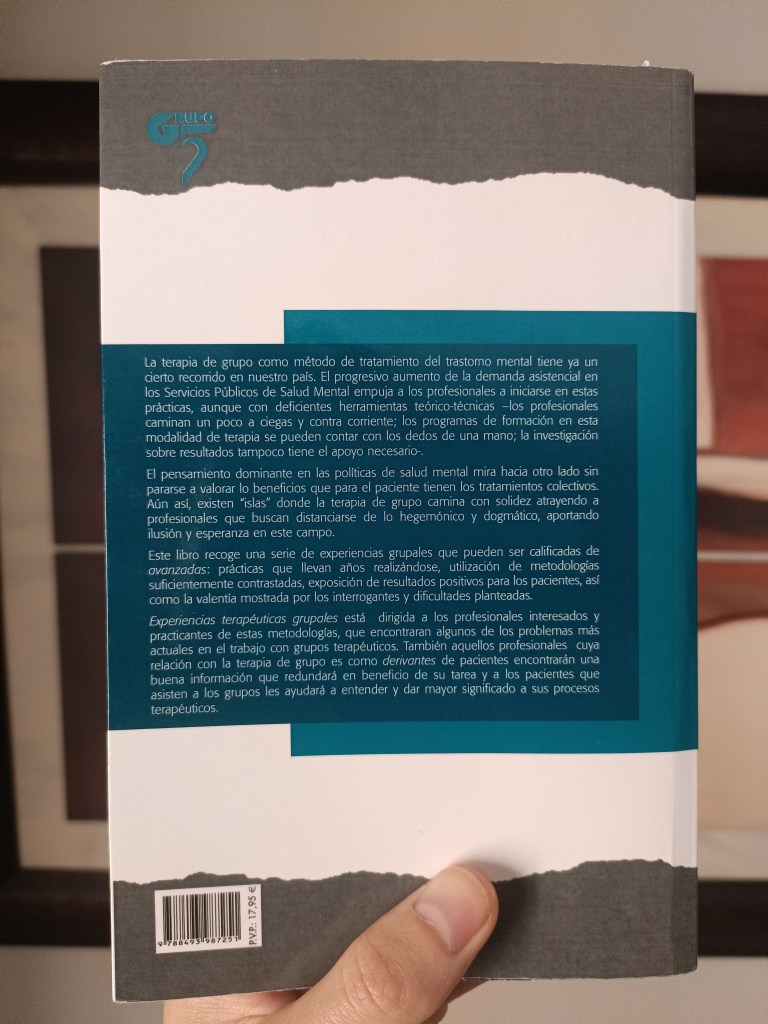
- Publication date: 2013
- Country: Spain
- Pages: 252
- Reading date: September 2022
- Rating: 4.25/5
The compilation of the scientific papers published in this book has been coordinated by Emilio Irazábal Martín, who is a clinical psychologist, social psychologist and psychotherapist. However, the set of authors of the essays compiled here amounts to 24, as the book collects the papers presented at the Jornadas sobre Trabajo Grupal en Salud Mental («Conference on Group Work in Mental Health») held in 2011 in Madrid. All of them belong to different public resources and mental health professions. In addition, this book is part of a series called Intersecciones y Fronteras de la Salud Mental («Intersections and Frontiers of Mental Health»), which was directed by the psychiatrist and psychotherapist Mariano Hernández Monsalve.
The other books published in this series are:
- Psicoterapia y rehabilitación de pacientes con psicosis (2011)
- Manual de psicoterapia interpersonal (2014)
- Salud mental y terapia grupal (2014)
- Situaciones grupales difíciles en Salud Mental (2014)

Within the list of other books published in this series, those for which there is already a post in this blog are highlighted.
Click on it to read it!
I started my internship as an Internal Nurse Resident (EIR) in Mental Health in Zaragoza in July 2021. From this experience I can say that one of the interventions which I have found most complicated and at the same time enriching has been the group work. One of my teaching tutors, during my time at the Psychiatric Day Hospital of the Miguel Servet University Hospital (HUMS), taught me about the functioning of Operative Groups, which I still have a lot to learn more about. Among his recommended readings, she lent me the book I am discussing in this blog entry.
As I mentioned earlier, this book is a compilation of papers presented at the Jornadas sobre Trabajo Grupal en Salud Mental («Conference on Group Work in Mental Health») held in Madrid in 2011. Many professionals from the social and health care field took part in them, so this book also carries such diversity of approaches.
«The patient and his family bring to the unit their own ambivalence in relation to change and their own contradiction between the conscious desire to change and the unconscious determination to defend and maintain their own pathological way of life, to which the patient is necessarily attached, having constituted for him, until now, the only way, albeit unsatisfactory, of living with his own anxieties, conflicts and deficits»
Antonio Tarí García
While it is true that many of the essays in the book are mainly psychoanalytic or psychodynamic in orientation, this is not uniform but rather heterogeneous. There are Kleinians, Lacanians, supporters of the Psychology of the Self, of Psychodrama, of the Operative group concept… Different psychological, philosophical and sociological approaches are present. All of them with a common objective, which is the group.
It is emphasised that group psychoanalysis is «another psychoanalysis», with a different way of organising itself, which should be further developed and put into clinical practice. The concept of «social psychology» is thus mentioned.
«Hospitalisation in a psychiatric unit for acute patients is usually a second traumatic experience in addition to the one that provoked the crisis. The deprivation of freedom (it is a closed unit) and the psycho-hygienic habits, healthy for us, but for the patient imposed and sometimes very different from those at home, easily transform the unit into a hostile environment in his or her imagination. Not to mention the patient’s fantasies and prejudices about what a psychiatric unit is and the fear of being assigned for life the role of a mentally ill person»
Rafael Arroyo Guillamón and Sara del Palacio Tamarit
On the other hand, the diversity in this set of essays can be seen not only in the theoretical approach, but also in many other aspects related to the group setting: age of the patients in the group, the facility where it takes place, patients’ diagnoses, objectives of the group, multi-family groups, topics treated, dilemmas which may arise…. All this breadth of scenarios and the excellent analysis of the group situation, its setting and its development in each chapter, has helped me to become aware of the complexity of good group therapy.
Reflection is essential, not only in terms of the aforementioned group setting, but also in terms of our own performance as professionals towards patients, towards our colleagues and towards ourselves. This emphasis on a good self-criticism of our interventions is something which has left me with a good taste in my mouth after reading this book.
«Patients who are admitted, largely against their will, forcefully exhibit the only thing they possess and can control, the symptom»
«In such mental disorganisation it is frequent that in their first days they oscillate defensively between fight and flight […] Both forms of communication separate and protect them from the other with the same force with which they fervently request help»
Rafael Arroyo Guillamón and Sara del Palacio Tamarit
I would like to highlight one of the chapters which I liked the most: the one in which they explain the setting up and development of a group made up of Day Hospital patients, in which the therapist uses films as psychotherapeutic tools and recounts her experience with the patients.
«We know that sense of humour is one of the most evolved defence mechanisms we humans have. Films often have comic moments which help us to approach problems with less emotional involvement and to relativise our previous stance. Laughter has a great capacity to change mood. Similarly, crying is a form of emotional catharsis; we cry at the cinema because we can vent our grief without being censured for doing so or accused of being weak or inadequate, because «it’s only a film»»
María Martín Martín-Blas
In conclusion, it has been a very motivating book for me to learn about therapy groups. I have not agreed with some statements or ideas in certain chapters, but it has encouraged me to reflect on and become aware of the complexity of group work in Mental Health, and I hope to continue learning from it.
Some reflections:
- What does it mean to you to feel part of a group?
- Would you say that absolutely all human beings need group social interaction? What do we get out of it? What do we expose ourselves to in it?
- What feelings might a person with mental health problems have when interacting with others? How would you act if you were that person?
- What would be your biggest concern if you were admitted to a Psychiatric ward in a hospital?
Type your e-mail address and click on subscribe to be notified of new content!
- I overcame the anorexia
- Yo vencí la anorexia
- Pensando en ellos
- Thinking about them
- Saldremos de esta: Guía de salud mental para el entorno de la persona en crisis
- We will get over this: A mental health guide for the environment of the person in crisis
- Traces of Madness: A Graphic Memoir
- Desmesura: Una historia cotidiana de locura en la ciudad
- When I sing, mountains dance
- Canto yo y la montaña baila
Cambia el idioma a:

 arquerociego
Which are the latest blog posts?