This book is a contemporary novel in North American literature.
Thus, it can be classified within the narrative genre in the form of a novel and subclassified into categories such as historical fiction and southern gothic.
This is a 10th reprint from 2015 of a first edition released by Ediciones B S. A. in 2009, which is a Spanish publishing house founded in 1987. It publishes books for adults (fiction and non-fiction), children, young adults, illustrated books and comics. Currently, since 2017, it belongs to the Penguin Random House group. This book is available in English.
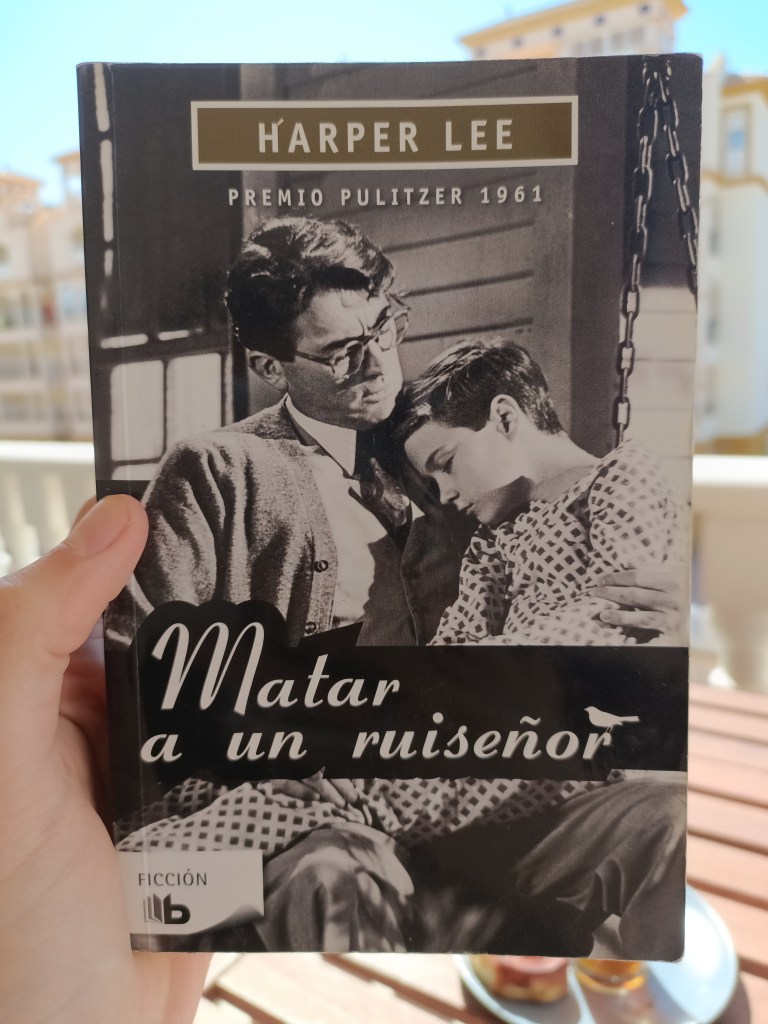
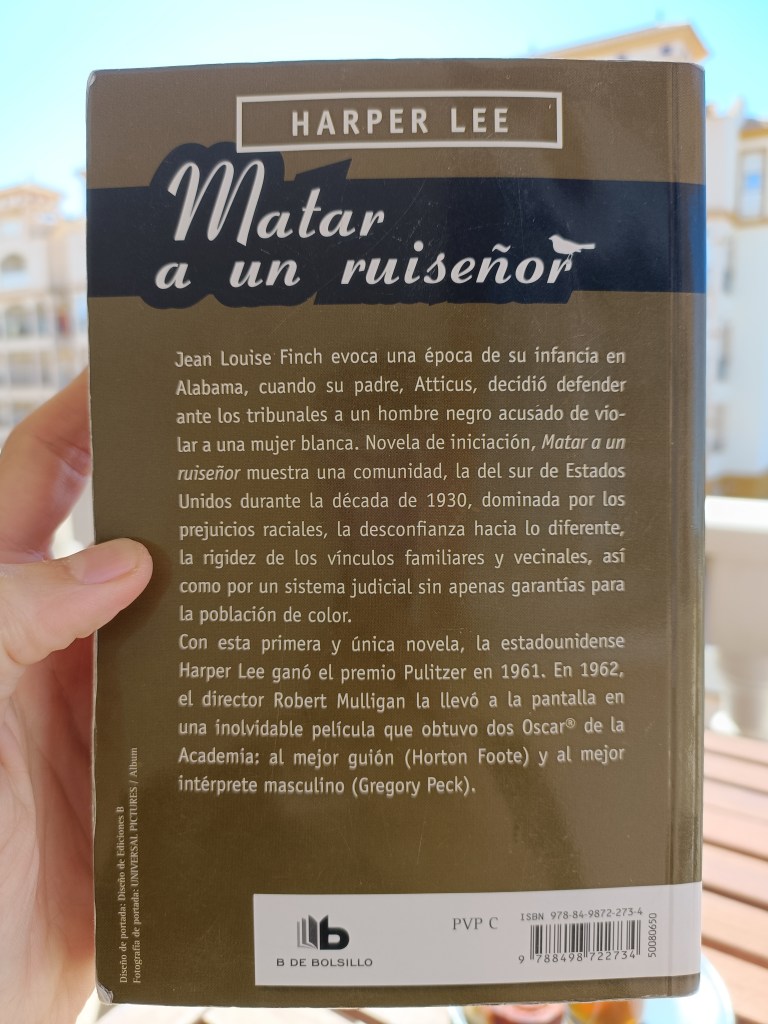
- Publication date: 1960
- Country: USA
- Pages: 410
- Reading date: September 2019
- Rating: 2/5
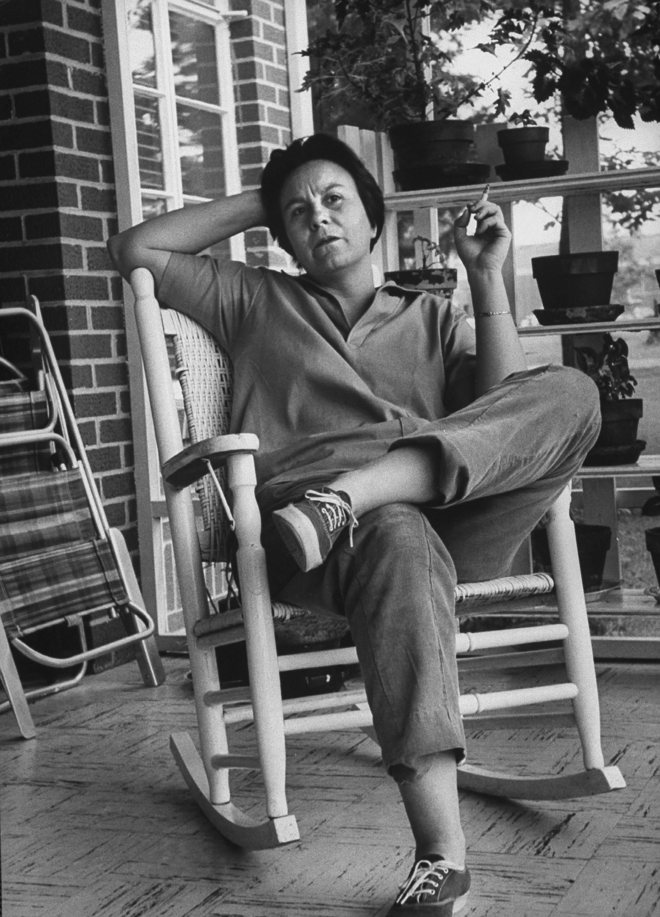
The author is Nelle Harper Lee (Monroeville, USA, 1926-Monroeville, USA, 2016). She was an American writer who won the Pulitzer Prize in 1961 for her novel To Kill a Mockingbird. It was her first and only novel, although in 2015 she published a draft of it that she had had since the 1950s under the title Go Set a Watchman. Before devoting herself to literature, she worked in the reservations department of an airline. She was friends with the writer Truman Capote. She did not give interviews and lived in retreat in her hometown. She died at the age of 89 of a stroke in a nursing home.
For some time I had been hearing about the book To Kill a Mockingbird by Harper Lee. I found it on one of my «book raids» in one of Madrid’s Tuuulibrerías (second-hand bookshops). It was at a time when several series and films of the social criticism type about racism in American society were released. I was interested in the subject, so I decided to read the book, as it was a contemporary classic which dealt with the issue.
I was surprised to discover the author had no other books and that it was this one which catapulted her to fame as a writer. This was a contrast because, despite the fame of her work, she had always led a life of withdrawal from the media. That detail and the fact that the work was partly autobiographical, recounting events from the author’s childhood, made me very curious.
«Mockingbirds don’t do one thing but make music for us to enjoy. They don’t eat up people’s gardens, don’t nest in corncribs, they don’t do one thing but sing their hearts out for us. That’s why it’s a sin to kill a mockingbird».
Miss Maudie

«Havin‘ a gun around’s an invitation to somebody to shoot you».
Jem
The story of the novel takes place in the fictional town of Maycomb in Alabama during the time of the Great Depression. The plot is divided into two parts. The first focuses on the childhood experiences of the protagonist Scout Finch, her older brother Jem, and a boy named Dill in the neighbourhood. Scout’s father, Atticus, is a lawyer, and is assigned to defend a black man named Tom, who is accused of raping a white woman. From that moment on, the second part of the novel begins, focusing on racial prejudice, Tom’s trial and the impact and outcome it has on the lives of the protagonist and the rest of the characters.
The work connects with different themes, not only racial prejudice and inequalities in the south of the USA, but also deals with the loss of innocence, gender roles, human dignity…
The book itself is a faithful portrait of southern US society at the time, with its prejudices and values. It is therefore read in schools as a contemporary classic on this historical theme.
«Cry about what? Cry about the simple hell people give other people without even thinking. Cry about the hell white people give colored folks, without even stopping to think that they’re people, too.”
Mr Raymond
“I think I’ll be a clown when I get grown – said Dill. Jem and I stopped in our tracks. -Yes sir, a clown, -he said-. There ain’t one thing in this world I can do about folks except laugh, so I’m gonna join the circus and laugh my head off. -You got it backwards, Dill, – said Jem-. Clowns are sad, it’s folks that laugh at them. – Well I’m gonna be a new kind of clown. I’m gonna stand in the middle of the ring and laugh at the folks».
Dill and Jem
Despite the interesting themes of the novel, both philosophical-ethical and historical, I found the author’s narrative style very dense. Especially in the first part of the book, in which Scout tells us about her life, her neighbourhood and the people in it, everything is narrated in great detail, which makes the narrative pace rather slow, too slow for my taste, getting lost in details which in my opinion are superfluous.
Maybe the author’s intention was to use them to portray the society and the southern life in the USA, but as I said, it was too boring to read this first part.
In the second part, when Atticus is asked to defend Tom at the trial, I found it easier to read. The pace and development of events were not lost in unimportant details and the message was easier to extract from the text.
«Until I feared I would lose it, I never loved to read. One does not love breathing».
Jean Louise Finch
In conclusion, To Kill a Mockingbird was a worthwhile read, as it is a classic and I wanted to have an opinion on a work that is so well known on the subject of racial injustice. The themes are very well dealt with, as is the construction of the characters, but I didn’t manage to connect with the author’s narrative style, which I found rather dense, lost in details of no importance to the main plot, especially in the first part of the novel. Sometimes we read a classic book expecting to love it, almost forcing us to do so given the social approval it holds, but in my case I was unable to do so. It was a worthwhile read but one that I won’t remember as a book that will change my life.
«When a child asks you something, answer him, for goodness’ sake. But don’t make a production of it. Children are children, but they can spot an evasion quicker than adults, and evasion simply muddles ‘em».
Atticus Finch
Some reflections:
- Would you recommend this book to address the issue of racism or do you have another book in mind?
- Is racism a social issue that interests you? What kind of racism are you most interested in analysing?
- How would you solve racial prejudice on a societal level, and do you think there is a way to diminish or eliminate it? Can literature help?
Type your e-mail address and click on subscribe to be notified of new content!
- Pensando en ellos
- Thinking about them
- Saldremos de esta: Guía de salud mental para el entorno de la persona en crisis
- We will get over this: A mental health guide for the environment of the person in crisis
- Traces of Madness: A Graphic Memoir
- Desmesura: Una historia cotidiana de locura en la ciudad
- When I sing, mountains dance
- Canto yo y la montaña baila
- The Phantom of the Opera
- El fantasma de la Ópera
Cambia el idioma a:

 arquerociego
Which are the latest blog posts?