This book is a contemporary novel in Spanish literature.
Thus, it can be classified within the narrative genre in the form of a novel and subclassified into categories such as psychological thriller and mystery novel.
This is a first edition released by Austral Editorial in 2010, which is a Spanish publishing house founded in 1937 as a collection of classic paperbacks within the Espasa Calpe publishing house. It is now part of Grupo Planeta and publishes a selection of paperback classics of contemporary literature. This book is available in English.
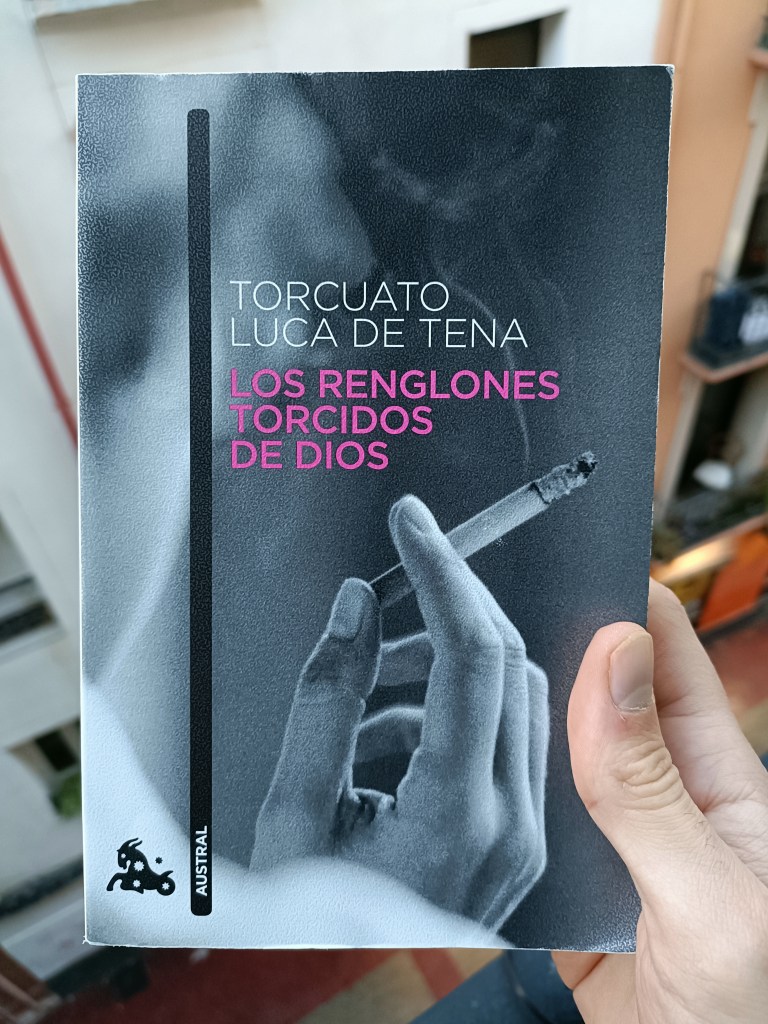
- Publication date: 1979
- Country: Spain
- Pages: 439
- Reading date: July 2022
- Rating: 3/5
The author is Torcuato Luca de Tena (Madrid, Spain, 1923-Madrid, Spain, 1999). He was a Spanish writer and journalist from a family of pro-monarchy journalists. He spent his youth in Chile, and in Spain he was editor of the conservative newspaper ABC and became a member of the Royal Spanish Academy (RAE). He later lived for some years in Mexico, where he devoted himself to his literary work. He died at the age of 75.
Other books by the same author are:
- Edad prohibida (1958)
- La brújula loca (1964)
- Los hijos de la lluvia (1986)
- Poemas para después de muerto y otras versificaciones (1990)

Within the list of other books published by the same author, those for which there is already a post in this blog are highlighted.
Click on it to read it!
The truth is that although God’s crooked lines is a relatively well-known book, I only started hearing about it around 2020. It was recommended to me by a couple of people and I kept it on my to-read list. It wouldn’t be until 2022 when, after some practical experience in Mental Health services in Zaragoza, I would sink my teeth into it after having heard a bit more about it.
One of the things which caught my attention in the book is that the author decided to be admitted into a psychiatric ward simulating a depressive psychosis in order to get to know the reality of the mental asylums first hand. This helped to give the book a better setting. The prologue to the book, written by the psychiatrist Juan Antonio Vallejo-Nágera, bears witness to this event.
«The real madness probably is not another thing that the wisdom itself that, tired of discovering the shames of the world, has taken the intelligent resolution to become mad».
Heinrich Heine
«He is not interested in talking to humans, because the conversations he has with extraterrestrials are much more interesting and instructive».
Ignacio Urquieta
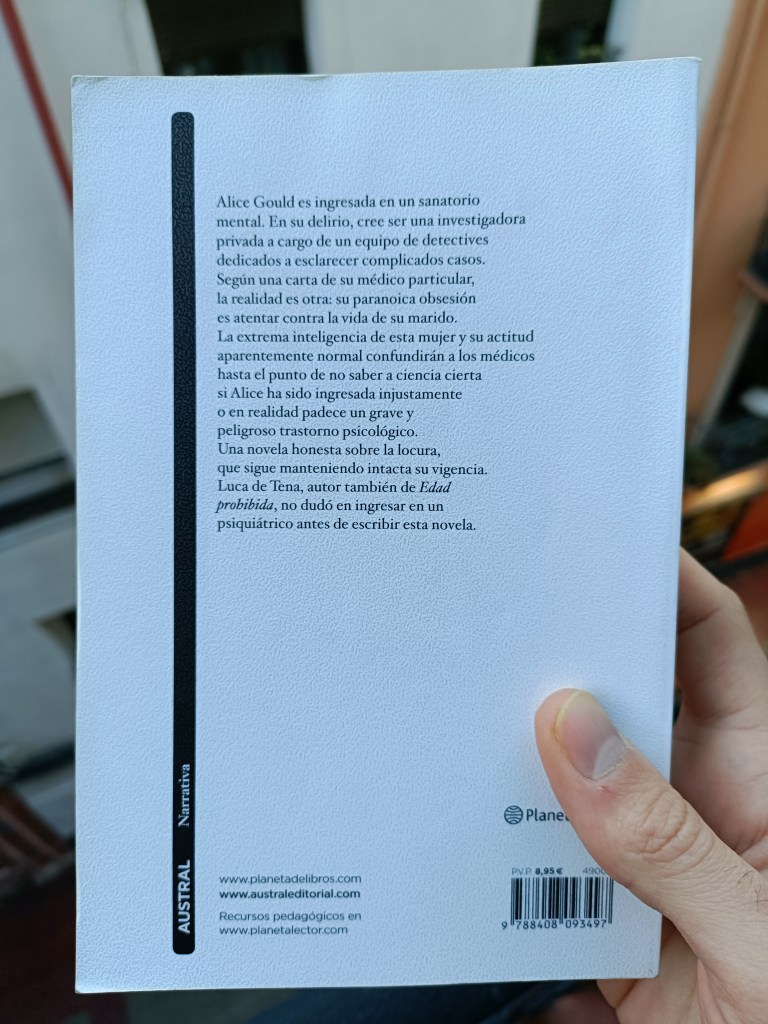
The plot of the novel introduces us to the protagonist Alice Gould, who enters an insane asylum pretending to be mentally ill with the aim of investigating a crime during her stay there, as her profession according to her is to be a detective.
That is the initial premise. The rest of the novel develops this plot and immerses the reader in a game in which he is forced to decide who Alice Gould really is.
As we read the novel, we can find clichés about mental illness and those who suffer from it (which still exist today), see the shock that admission to an asylum entails for the protagonist and learn about this reality which was alien to her, as well as the feelings which the other people in the asylum awaken in her. Thus, in this novel, the author crudely exposes themes such as mental illness, suicide, self-harm, disinhibition, delirium…
The description of the functioning of the Psychiatric Hospital in the novel shows us the situation that existed in Spanish insane asylums between 1970-1980. It is interesting to observe the conflict within the Psychiatric Hospital itself between two different ways of understanding Psychiatry and the treatment of the mentally ill. The author’s aim is, on the one hand, to present these mentally ill people from a human perspective, empathising with them and seeing them as worthy of being treated with consideration. And on the other hand, to praise the work of the people who care for these patients.
«She soon found a code that distinguished all the inhabitants of «the Cage» from those of the rest of the asylum. Those who roamed free in the park, those who lived together in the central building, were in communication with each other. They knew how «the others» moved, spoke and behaved. And that was the big difference. For the inhabitants of «the Cage», «the others» did not exist. The vast majority of the insane were not capable of being attentive to anything, but those who could fix on something in their thoughts, directed them towards entelechies anchored in their past or in their delusional hallucinations. And so, the insufferable woman standing before Alice accusing her (…) was not really talking to her, but to her ghosts, to her spectres, to her goblins. In the «Hall of the Forsaken», the madmen suffered their ills «in company». Here, they were all alone with their chimeras».
Torcuato Luca de Tena (narrator)
I find it difficult to describe Torcuato Luca de Tena’s prose in this book. I would say that it is direct, rich and complex, but on the other hand it is somewhat heavy, repetitive, with unnatural dialogues and an irregular narrative rhythm, which makes it lose the interest maintained by the plot twists and other elements of intrigue such as the enigma «is Alice Gould crazy or is she sane and the smartest?«.
I also think everything focuses too much on the main character and that other characters such as Ignacio Urquieta, with a lot of potential, end up being somewhat wasted.
«Ah, how terrible is the fate of the poor madmen, those ‘crooked lines’, those mistakes, those misspellings of the Creator, as ‘the Author of the Theory of the Nine Worlds’ called them, unaware that he was one of the crookedest of all the lines of divine handwriting!».
Torcuato Luca de Tena (narrator)
The premise is good, although many fiction novels under the banner of Mental Health deal with the investigation of a crime in a Psychiatric Hospital. The characters, the setting and certain moments of intrigue are very well done. However, as the plot progressed, I grew a little tired of the protagonist, and many of the supposedly dramatic turns of events lose steam because of the aspects of the author’s prose I mentioned earlier.
In conclusion, God’s crooked lines is a book I recommend if you want to read some classic fiction about Mental Health and Psychiatry in Spain at that time, but it is not a super necessary read if what you prefer is to really learn about the life experiences of people with a mental problem or to gain more academic knowledge.
«Here is a word, «silence», which man has invented to express a reality he has never experienced, to describe what he has never known: because everything in him and around him is an accumulation of minimal rumblings. And the voice which once sounded is not lost forever. The vibration of the sound wave expands and recedes, but it remains forever. This conversation we are having, doctor, will exist in the future somewhere far away».
Alice Gould
Some reflections:

- What do you know about 20th century insane asylums in Spain?
- What similarities do you find between genius and madness?
- What do you think about the fact that the author of the book pretended to be a mentally ill person in order to get to know the institutional environment and to be able to better set the scene for his novel?
Type your e-mail address and click on subscribe to be notified of new content!
- I overcame the anorexia
- Yo vencí la anorexia
- Pensando en ellos
- Thinking about them
- Saldremos de esta: Guía de salud mental para el entorno de la persona en crisis
- We will get over this: A mental health guide for the environment of the person in crisis
- Traces of Madness: A Graphic Memoir
- Desmesura: Una historia cotidiana de locura en la ciudad
- When I sing, mountains dance
- Canto yo y la montaña baila
Cambia el idioma a:

 arquerociego
Which are the latest blog posts?