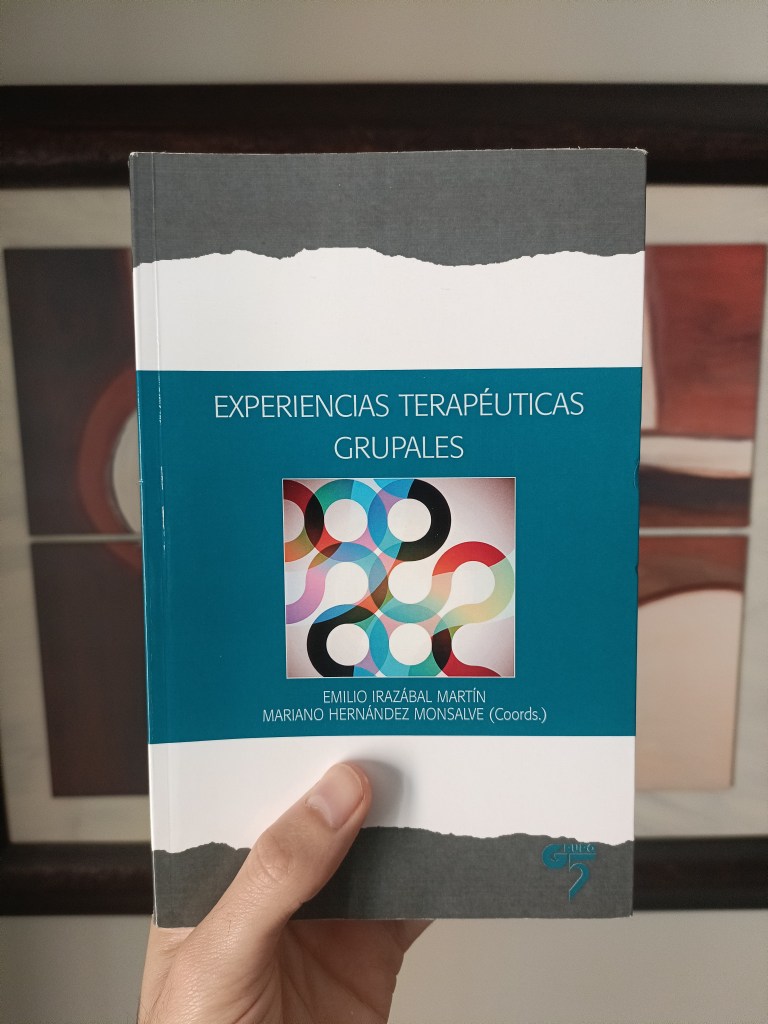
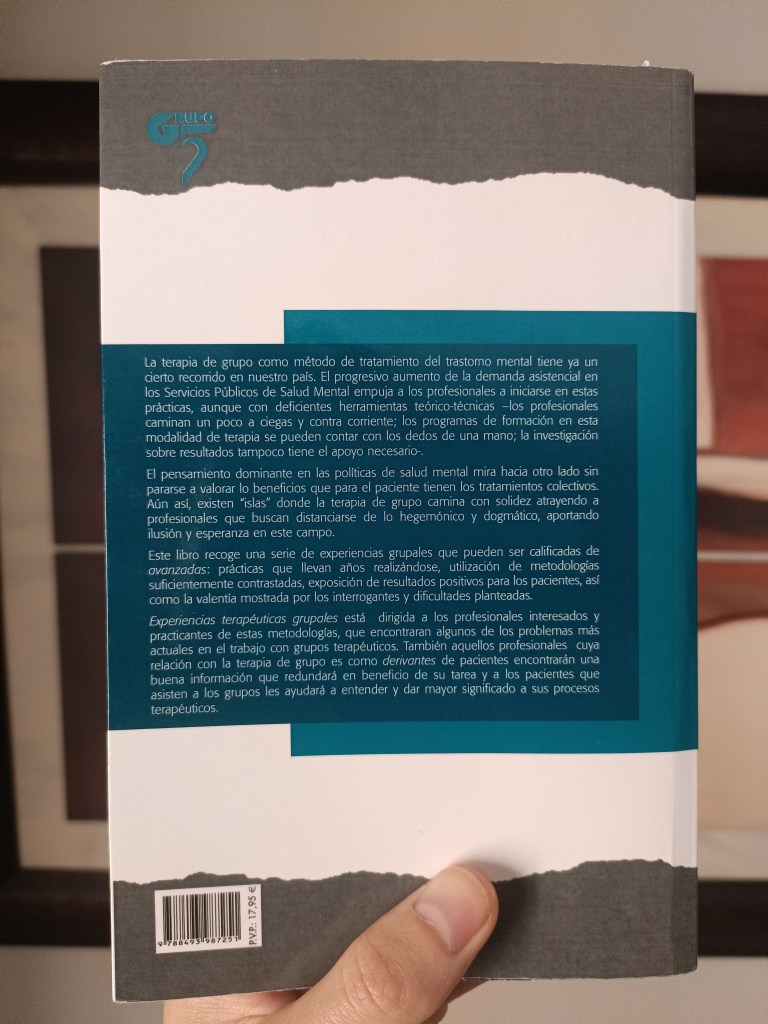
This book is the result of a compilation of scientific papers or essays on group therapy in different areas of mental health and complicated situations that can occur in such groups.
Thus, this book can be classified within the didactic genre in the form of a set of essays or scientific papers and subclassified among those in the field of Psychology.
This is a single edition published by Editorial Grupo 5, which is a Spanish publishing house that publishes books for the education and training of professionals working in the field of social and health services. This book has not been translated into English.


- Publication date: 2014
- Country: Spain
- Pages: 450
- Reading date: May 2023
- Rating: 4.5/5
The compilation of the scientific papers published in this book has been coordinated by Emilio Irazábal Martín, who is a clinical psychologist, social psychologist and psychotherapist. The book brings together 18 essays addressing different issues surrounding therapy groups in Mental Health. All of them belong to different public resources and mental health professions. In addition, this work is part of a series called Intersecciones y Fronteras de la Salud Mental («Intersections and Frontiers of Mental Health»), which was directed by the psychiatrist and psychotherapist Mariano Hernández Monsalve.
The other books published in this series are:
- Psicoterapia y rehabilitación de pacientes con psicosis (2011)
- Experiencias terapéuticas grupales (2013)
- Manual de psicoterapia interpersonal (2014)
- Salud mental y terapia grupal (2014)

Within the list of other books published in this series, those for which there is already a post in this blog are highlighted.
Click on it to read it!
This book was one of the recommended readings during my internship as an Internal Nurse Resident (EIR) in Mental Health in Zaragoza (2021/2023). One of my teaching tutors, a specialist nurse in Mental Health at the Psychiatric Day Hospital of the Miguel Servet University Hospital (HUMS), lent me this book to study in depth the Operative Groups, Pichon-Rivière’s theory and the problems or phenomena likely to occur during group therapy.
In the different chapters of the book, each one of them an independent essay, many professionals from the health and social care field took part, which is why this book also carries such a diversity of approaches.
«In agreement with several authors, we have personally characterised the group as the heir of the ego function, that which occurs in the proto-bond. The group would then be the subject’s support because of its potential capacity to provide continence and decipherment; to be a space for processing, elaboration and symbolisation; because of its possibility of generating conditions to name the unnameable, giving rise to thought and word»
«The group device has the particularity of being a space for re-editing the everyday. At the same time, it offers the possibility of a break with what is called an uncritical familiarity with regard to our being and happening in everyday life»
Ana Pampliega de Quiroga
The prevailing approach running through all the chapters of this book is that of the psychiatrist Pichon-Rivière, creator of the group theory known as the Operative Group. This theory and its vision of the subject, of subjectivity and of the bond is exhaustively introduced in the first part of the book. It is differentiated from classical Psychoanalysis and presented as a key element of Social Psychology or of a Psychoanalysis with group applications.
«Let us descend to the concreteness of a being thrown into the world, a social being, who is linked to the community of the planet and therefore unfinished and different, who tries to organise his life around a project which includes his own death. A being, however, who feels, who perceives that the burning core of his being does not appear anywhere, but is expressing itself through allusions, hints, (…). This is the subject of investigation, which appears where it is not sought and escapes any control. It is the subject of the continuous transformation of reality that we call the operative subject»
Leonardo Montecchi
It is interesting to appreciate the excellent introduction of our historical and socio-cultural context in this first part of the book. This approach is carried out from a more sociological point of view, which is nonetheless necessary, and which serves as a prelude to the following 18 chapters dealing with more concrete, everyday situations in working with groups in Mental Health.
«The arrival of an «open, plural, flexible society, based on information, human needs, and in which institutions would adapt to the motivations of the subjects» (…) was enthusiastically announced. This new social form would be based on the law of enjoyment, with infinite freedom of choice in the different spheres of existence, and in which access to goods would be absolute. Personal fulfilment, being oneself and from oneself, would become the defining value of the new society. At the same time, the idealisation of one’s own desires, the fantasy of unlimited gratification, would necessarily rethink the place of the other, of others, of groups in the needs and project of the subject. According to this account, in this idealised universe, respect for diversity would reign. However, from this narcissistic point of view, the other lost significance as a source of gratification, or, even more seriously, could be an obstacle to it. The paradise of the individual then implied atomisation and social fragmentation (…) A disillusionment, a melancholy suffering, arose for many in their relationship with power, with themselves and with others, which became, and still persists, in a culture of complaint, a perception of the world and of life itself from what was not and will not be»
Ana Pampliega de Quiroga
«The group situation was and is often no longer seen as a support, but as a strange, risky and inauthentic environment (…). This positioning, although in contradiction with others, persists even today. We speak of contradiction because we also find in the group-relationship field the longing for protection, for listening, for feeling safe, for recovering the support that was at the origin of one’s own subjectivity»
«Finally, I would like to point out another feature present today in social life, which permeates the bonds and which questions us as mental health workers. We are referring to a new culture: the culture of immediacy, the culture of everything now, the culture of intolerance to waiting (…). This culture of immediacy, of consumption, of rapid expiration, brings us back to one of the great current ailments. We are talking about the disturbing anxiety that emerges when we must situate ourselves, orient ourselves, in a socio-historical order in global crisis. An order in which ambiguous, uncertain, unpredictable conditions dominate. An order in which it is difficult to anticipate the future, the necessary elaboration of a project. This instantaneousness, imposed and assumed, the intensity and vertiginousness of the search for answers, installs a new experience of temporality and can become a culture of risk and frustration. The illusion of immediate gratification and its failure would potentiate – in a vicious circle – over-demands towards oneself and towards others, different forms of violence in relationships, as well as experiences of loss and threat»
Ana Pampliega de Quiroga
Turning to the chapters that reflect on different problems or difficulties which may arise during group therapy, it is worth mentioning that the situations described are very diverse. There are essays reflecting on the patient’s families and relatives and their participation in the groups and in the community. Others reflect on very delicate and complicated situations to handle such as the suicide of a patient in the group, a situation of physical aggression by a patient towards the mental health team or patients not attending the group.
The setting of the group of patients described in each essay is different, as there is diversity in terms of their ages and diagnoses, as well as in the objectives and topics to be dealt with in the group itself. The Mental Health network facilities where each chapter’s group takes place also vary.
«Family dysfunction puts us on the tracks of the family plot, they are its emergence, and the symptoms are the formal envelopes of the stories they mask»
«It is necessary to create the space (physical and symbolic) of the group. It is necessary to connect with the need, opening a space for it in the imaginary. And there are often needs which are invisible (…). When a need is made invisible or naturalised, although it exists and generates discomfort for people, the discomfort does not act as a driving force for that need to ask for help; because a naturalised discomfort implies there is ignorance or denial about issues that can be worked on and improved by means of a group»
Paloma de Pablos Rodríguez / Elena Aguiló Pastrana and Ayelen Losada Cucco
I could go on mentioning chapters of the book about complicated group situations and problems that can occur in a therapy group, but from here I would like to focus on other chapters which I found very necessary and interesting. They are those dedicated to reflecting on the work of the Mental Health professional.
There are two types of chapters in the book that deal with this subject, but from different perspectives:
Some think about the difficulties that we, as Mental Health workers, can encounter when we are learning to look at these patients, and how our gaze plays an important role in the improvement or rehabilitation of these people. These are reflections pointing to a healthy and necessary self-criticism in order to continue improving as people and as professionals.
«We professionals often insist on believing that users have to follow us, to behave as we need them to. This means blocking our senses so as not to see or listen, with the following consequences: chronicity is maintained, as well as the professional’s position of wisdom and the users, meanwhile, are in their own world, a world that cannot be shared because it does not seem to be listened to either»
«Sometimes there is too much noise and interference («this patient is very serious», «does not respond to treatment», «is at constant risk of suicide», «has too many admissions», «has been isolated for years», «psychotic psychopathology persists», «has a dysfunctional family», «there is a risk of becoming chronic»). How does the team listen? How does it register this information which seems to be closer to the emotional than to knowledge?»
Inmaculada Casillas Tejeda / Elena Aguiló Pastrana and Ayelen Losada Cucco
On the other hand, other chapters deal with the work of the Mental Health professional, analysing the internal conflicts which they present as workers in this field. Such reflections express the feelings and doubts of those who adopt the role of helping others, and give voice to the anguish sometimes involved and why it is therefore so necessary to share them, to unburden them, to look at them and confront them.
«The conflict between the duty of care and respecting the patient’s freedom is contaminated by the emotions aroused in me by the rejection. Each of these reactions in turn produces mixed emotions in me, guilt for the aggressiveness that the obligation entails, or guilt for the abandonment, the lack of care and the surrender of what our professional ethics impose on us. On other occasions I have been able to feel a kind of affective anaesthesia based on neglecting, emotionally dismissing these communications of annoyance and rejection, and on others a state of demoralisation characterised by the elimination of the possibility of feeling that I have something good in me, that I have something good to offer, that my proposal for group treatment is something that can be useful to them»
«I try to discriminate what it is that hurts me in this situation. It is not so much the patient’s rejection as the rejection linked to the obligatory nature of the link, almost experienced as a condemnation. Who is forcing me? The institutional mandate, but what is in this mandate? A good therapist is one who never rejects serious patients, whatever their behaviour, never renounces to cure them, cannot experience hatred towards them, and if he does experience it, he must silence it and make it disappear or endure it»
Antonio Tarí García
This book has helped me a lot. I have been able to learn more about Pichon-Rivière’s vision of groups and subjectivity. It has awakened my interest to read more of this author, to approach his main works, and to continue to deepen my understanding of the operative group.
The problems or difficulties appearing during a therapy group must be taken into account for an adequate resolution, adaptation or response to them. I consider this book presents an interesting variety of such phenomena and it is interesting to read about the experiences of other Mental Health colleagues in dealing with them.
Finally, I would like to highlight that the chapters or reflections I liked the most were those on professional work, because asking ourselves why we do what we do and think what we think is the basis of good practice in Mental Health, as well as giving voice to it and knowing how to share it in order to give expression to our internal conflicts.
In conclusion, a more than recommendable reading for anyone dedicated to this field of knowledge and, in particular, interested in therapy groups.
«They ask by actions, because they have not had access to wish-fulfilment. A deaf-and-dumb and blind man (…) coughs and receives a spoonful of syrup in response»
Diego Vico Cano
Some reflections:

- What does subjectivity mean to you?
- What do you think bonds are necessary for? What is a bond?
- What feelings can a person working in Mental Health have? What conflicts do you think you would face?
- What problems or difficulties have you had in the different groups you are part of? Have these events influenced your self-perception? Does your self-perception of yourself influence your health? In what way?
Type your e-mail address and click on subscribe to be notified of new content!
- I overcame the anorexia
- Yo vencí la anorexia
- Pensando en ellos
- Thinking about them
- Saldremos de esta: Guía de salud mental para el entorno de la persona en crisis
- We will get over this: A mental health guide for the environment of the person in crisis
- Traces of Madness: A Graphic Memoir
- Desmesura: Una historia cotidiana de locura en la ciudad
- When I sing, mountains dance
- Canto yo y la montaña baila
Cambia el idioma a:


 arquerociego
Which are the latest blog posts?