This book is a brief guide to dog training and behaviour.
Thus, this book can be classified within the didactic genre in the form of a guide or practical essay and subclassified among those in the field of Ethology.
This is a single edition self-published by the author himself and sold independently on his website https://hablaconellos.com in digital format. This book has not been translated into English. This book is not available in English.
Publication date: 2019
Country: Spain
Pages: 127
Reading date: March 2022
Rating: 5/5
Rafael Cal Estrela is the author of this brief guide to dog behaviour and training. He works as a dog trainer with an emotional and relational approach to animal behaviour and also acts as an ethical educator on dog training and human-dog coexistence on social media. In addition, he teaches several courses on his website. His vocation began with his own personal experience with his dog ‘Oso’, who had emotional problems.
During part of the time I lived in Zaragoza (2021-2024), my partner decided to take a dog training course, as she has always been passionate about animals, especially dogs. The course included both theory and practical sessions, and when she came home, she would talk to me about all kinds of issues related to dog behaviour and training. I had always been interested in Biology and Psychology, but I had never really looked into dogs specifically. She recommended that I follow Rafael Cal, the author of this book and a professional dog trainer, on social media. After seeing his content, I was curious to read the book he was selling on his website, so I bought it and decided to read it at that time.
«Is there any wild animal on the planet that gets its food in a bowl, ready to eat, without having to make any effort to obtain it? No, there isn’t. These facilities for obtaining food only exist in the case of domestic animals. But if these animals were loose in the wild, no one would put food on a plate for them, which would give them a continuous motivation to obtain it«.
Rafael Cal Estrela
Although the book deals with concepts of ethology or animal behaviour, it is not an academic book in terms of how it is written. Rather, it aims to reach a wide audience with formal language that lends seriousness to the subject matter, but is simple and accessible, using practical examples to better understand certain concepts.
«Anger is meant to AFFECT the dog. Just like with people. I don’t want to scare a loved one when I’m angry with them; I want them to understand my anger and be affected by it. We need to be clear about what we want to achieve when we get angry. We should not get angry with our dog with the intention of scaring them. Fear is a negative emotion that causes insecurity and weakens the bond. No one wants to be with someone they fear, and if they do, we have a problem in the relationship. We have to get angry with our dog with the intention of affecting them, of making them understand that we do not like it and that it causes social discomfort in our bond».
Rafael Cal Estrela
The approach is emotional and based on the human-animal bond. It covers various topics ranging from the bond itself, affection, boundaries, behaviour modification, the needs of dogs when out walking, the development of their senses, to the topic of environmental enrichment. It also includes a section explaining dog training commands.
«Let’s put aside thoughts like, ‘I’m spoiling him too much’ or ‘Don’t give him so much attention.’ Nobody thinks that way about their partner; you try to give your all in a relationship. It’s the same with dogs. Don’t think about whether you’re spoiling him too much or not, just love him, love him a lot. If you want to play a game with him that you both enjoy, do it for as long as you want».
Rafael Cal Estrela
What I found most satisfying about the book is that it is very visual, which makes it easy to read, along with language which is easy to understand even if you have never explored these topics in depth. It is overflowing with respect and affection for these animals, which shows how passionate he is about his work, something which I think also enriches the reading experience.
In conclusion, this guide is highly recommended whether you are simply interested in this topic, have just begun studying dog training, want to better understand your dog, or are thinking about getting one.
Some reflections:
Do you think dogs are man’s best friend?
What have you learnt most recently about caring for them?
Do you think it is possible to meet their needs in an urban environment?
Type your e-mail address and click on subscribe to be notified of new content!
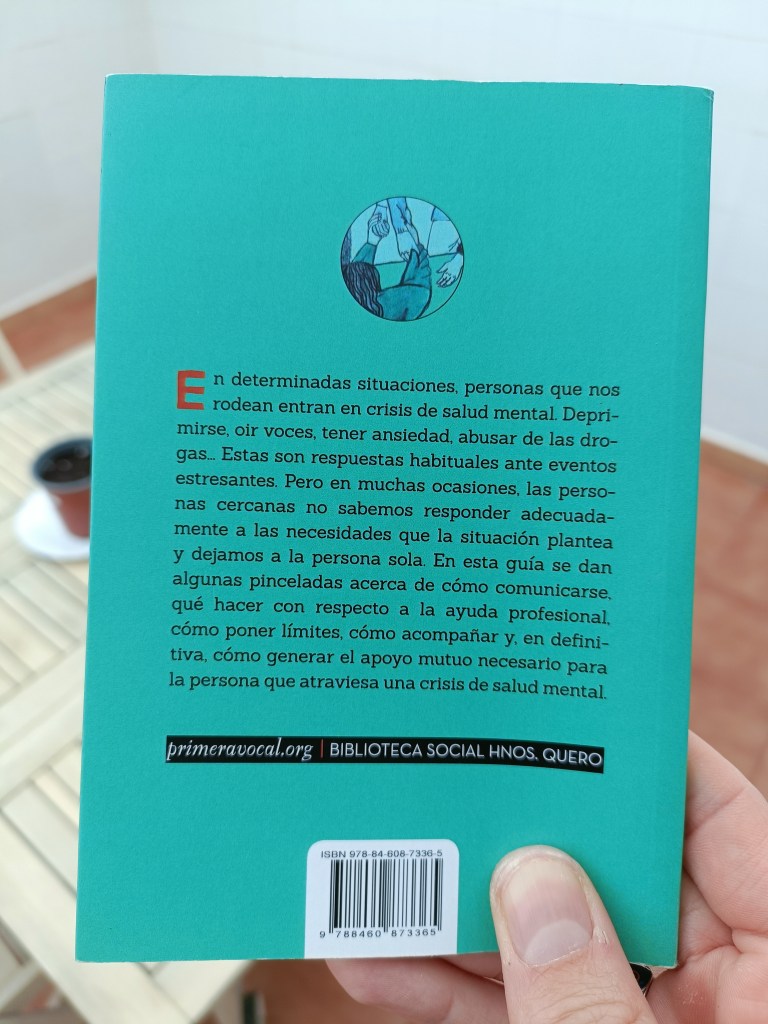
This book is a general guide to mental health for helping people in crisis.
Thus, this book can be classified within the didactic genre in the form of a guide or practical essay and subclassified among those in the field of Psychology.
This is a single edition (4th reprint) launched jointly by Primera Vocal and Biblioteca Social Hnos. Quero. On the one hand, Primera Vocal defines itself as a simple and humble project that aims to make texts accessible to help see connections between mental health and critiques of capitalism. On the other hand, Biblioteca Social Hnos. Quero was founded in 2003 to respond to the collective need for a space in Granada that promotes political education and self-organisation. It is an autonomous and self-managed project. This book is not translated into English.
Publication date: 2016
Country: Spain
Pages: 74
Reading date: February 2023
Rating: 5/5
Javier Erro is the author of this mental health guide for those around people in crisis. He works as a psychologist and researcher. He is also an activist involved in mental health and critical Psychiatry.
Other books published by him are:
Birds in the head. Mental health activism from Spain and Chile (2021)
Discomfort is something else. On the need to broaden our notion of suffering (2025)
Within the list of other books published by the same author, those for which there is already a post in this blog are highlighted.
Click on it to read it!
During the summer of 2022, I travelled to Asturias with my partner and we stayed in Oviedo. On one of our walks around the city, I came across a bookshop, whose name I cannot remember, which was also a social club with a catalogue of books on political, philosophical, social and critical topics. Looking at the shelves, my eyes fell on this book. It was in the critical Psychiatry section, and I thought it might be useful in my clinical practice with patients and their families, as I was doing my Internship as a Mental Health Nurse in Zaragoza (EIR) at the time.
«One aspect to bear in mind is that professionals do not “cure”. They provide resources, tools and information, and can offer support when it comes to expressing emotions. These strategies can alleviate suffering and even reduce it significantly, but it rarely disappears completely. Understanding these limitations can help us to have more realistic expectations and to get involved in a healthier way, both for ourselves and for the person in crisis«.
Javier Erro
The book is written in simple, direct language. It is perfect for those who are less familiar with mental health issues. It can be read by people with these problems, professionals, and those close to someone suffering from mental illness. I believe the book strikes a perfect balance between being critical of issues such as help, boundaries, medication and the therapeutic relationship, and being conciliatory and peaceful, offering a first human approach to these issues.
«One way to understand the role of psychiatric drugs is to think of them as crutches. They do not take away the pain in our leg, nor do they make a broken bone heal faster. However, they allow us to walk when we have a bad leg, and we cannot ask for more or less than that».
Javier Erro
The topics covered are varied, as are the different questions. Some of them are, for example, suicide, self-harm, psychotic symptoms such as delusions, paranoia and hallucinations, depression, mania… These are in a more clinical category, but it does not forget to address issues related to the helping relationship, hospital admissions, the person’s social environment, communication with them… I think that for such a short book, it is quite concise and to the point, dealing with the important issues.
«If someone close to you says they are having a hallucination, or you think they are having one based on what they say or do, the first thing to do is stay calm. The last thing they need is to see someone reacting with fear, aggression, incomprehension or laughter. Nor should you be patronising. We should try to understand them, talk to them if they want to talk, help them calm down and let them know that we are there for them. They may also want to be alone. In this case, we should respect their wishes as long as there is no risk involved».
Javier Erro
The part I liked the most is the one about the social environment of people with mental health issues. The way it deals with the issue of helping relationships, communication, bonds, stigma… is very human and sensitive. It gives this factor a well-deserved weight and importance that is often overlooked. This contextual aspect of the person is essential and vital in recovery and in dealing with crises and breakdowns.
«In any case, it should be borne in mind that the less information the environment has, the less social support there will be, and the less support there is, the more effort will be required of those who do have such information».
«This is not a protocol. In mental health, there can be no protocols. Situations can be extremely complicated, with multiple factors involved that we often do not even know about at first, and that we will probably never know about. But at the same time, starting from a position of ignorance is much better than acting on predetermined ideas, rumours, advice from dubious websites, or professionals with narrow mindsets. To learn, we must communicate, and this can be a good starting point. So, this is a call to lose our fear. If we communicate with the person and help them get through this difficult time, we are not being authoritarian, but understanding. Most likely, their social network will be diminished by what is happening to them, and as a result, their freedom as a person will be reduced. Without the mutual support of those around them, they will only have professional help, and sometimes this is enough, but more often than not, it is not. Beyond the effectiveness of treatments and interventions, in this short text we will try to find a new, healthier and more reasonable way of relating to each other. If our friend thinks that aliens want to abduct him, or that this life is not worth living, we will have to be the first ones there. Against the aliens and, perhaps, against this life».
Javier Erro
The tone of the writing is humble, approachable and self-critical. A book like this is welcome in this field, as it brings to light real dilemmas and the coherence of someone who only seeks to help and accompany others.
«We all have mental health, and it can be better, worse, or on a roller coaster. For many years, our idea of mental health has been reduced to mental health problems. Only considering it when it causes us problems suggests that in other circumstances it is a factor we should not pay attention to and that mental health is a problematic issue in itself. This leads us to not know how to react when these problems are very complex or seem strange to us, forgetting our ability to support each other and also hiding the reality that psychological suffering is much more common than we think (if not universal). Therefore, the first thing we wanted to make clear is that we should not only react to a person’s problems when they are already in crisis, but that the ideal would be to learn to take care of each other on a daily basis».
Javier Erro
In conclusion, this is a highly recommended guide for family members and others close to someone with mental health issues, as well as for the individuals themselves and for trained or trainee professionals. I have lent this book to residents and students, and they have found it very satisfying to read, both as an introduction and as a comprehensive and concise summary. A book that breaks down the stigma surrounding mental health.
Some reflections:
Do you think that a person’s environment is decisive in their recovery? Why?
Who is your greatest support in difficult times?
What do you need from the person who is with you to listen to you better?
Type your e-mail address and click on subscribe to be notified of new content!
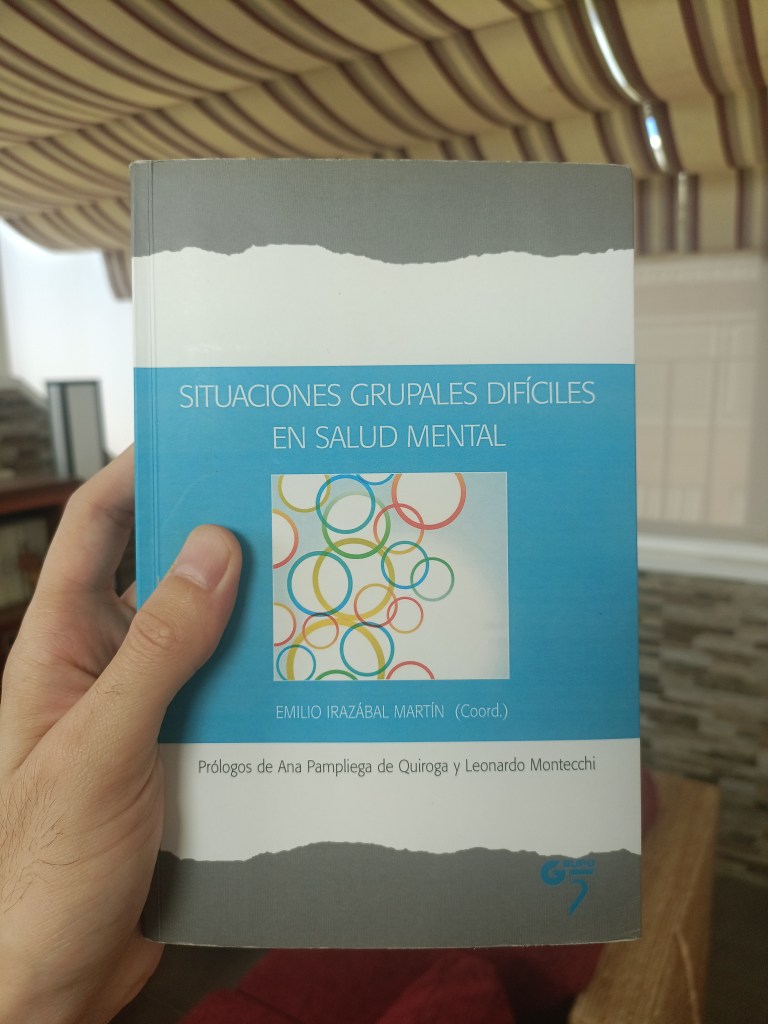
This book is the result of a compilation of scientific papers or essays on group therapy in different areas of mental health and complicated situations that can occur in such groups.
Thus, this book can be classified within the didactic genre in the form of a set of essays or scientific papers and subclassified among those in the field of Psychology.
This is a single edition published by Editorial Grupo 5, which is a Spanish publishing house that publishes books for the education and training of professionals working in the field of social and health services. This book has not been translated into English.
Publication date: 2014
Country: Spain
Pages: 450
Reading date: May 2023
Rating: 4.5/5
The compilation of the scientific papers published in this book has been coordinated by Emilio Irazábal Martín, who is a clinical psychologist, social psychologist and psychotherapist. The book brings together 18 essays addressing different issues surrounding therapy groups in Mental Health. All of them belong to different public resources and mental health professions. In addition, this work is part of a series called Intersecciones y Fronteras de la Salud Mental («Intersections and Frontiers of Mental Health»), which was directed by the psychiatrist and psychotherapist Mariano Hernández Monsalve.
The other books published in this series are:
Psicoterapia y rehabilitación de pacientes con psicosis (2011)
Within the list of other books published in this series, those for which there is already a post in this blog are highlighted.
Click on it to read it!
This book was one of the recommended readings during my internship as an Internal Nurse Resident (EIR) in Mental Health in Zaragoza (2021/2023). One of my teaching tutors, a specialist nurse in Mental Health at the Psychiatric Day Hospital of the Miguel Servet University Hospital (HUMS), lent me this book to study in depth the Operative Groups, Pichon-Rivière’s theory and the problems or phenomena likely to occur during group therapy.
In the different chapters of the book, each one of them an independent essay, many professionals from the health and social care field took part, which is why this book also carries such a diversity of approaches.
«In agreement with several authors, we have personally characterised the group as the heir of the ego function, that which occurs in the proto-bond. The group would then be the subject’s support because of its potential capacity to provide continence and decipherment; to be a space for processing, elaboration and symbolisation; because of its possibility of generating conditions to name the unnameable, giving rise to thought and word»
«The group device has the particularity of being a space for re-editing the everyday. At the same time, it offers the possibility of a break with what is called an uncritical familiarity with regard to our being and happening in everyday life»
Ana Pampliega de Quiroga
The prevailing approach running through all the chapters of this book is that of the psychiatrist Pichon-Rivière, creator of the group theory known as the Operative Group. This theory and its vision of the subject, of subjectivity and of the bond is exhaustively introduced in the first part of the book. It is differentiated from classical Psychoanalysis and presented as a key element of Social Psychology or of a Psychoanalysis with group applications.
«Let us descend to the concreteness of a being thrown into the world, a social being, who is linked to the community of the planet and therefore unfinished and different, who tries to organise his life around a project which includes his own death. A being, however, who feels, who perceives that the burning core of his being does not appear anywhere, but is expressing itself through allusions, hints, (…). This is the subject of investigation, which appears where it is not sought and escapes any control. It is the subject of the continuous transformation of reality that we call the operative subject»
Leonardo Montecchi
It is interesting to appreciate the excellent introduction of our historical and socio-cultural context in this first part of the book. This approach is carried out from a more sociological point of view, which is nonetheless necessary, and which serves as a prelude to the following 18 chapters dealing with more concrete, everyday situations in working with groups in Mental Health.
«The arrival of an «open, plural, flexible society, based on information, human needs, and in which institutions would adapt to the motivations of the subjects» (…) was enthusiastically announced. This new social form would be based on the law of enjoyment, with infinite freedom of choice in the different spheres of existence, and in which access to goods would be absolute. Personal fulfilment, being oneself and from oneself, would become the defining value of the new society. At the same time, the idealisation of one’s own desires, the fantasy of unlimited gratification, would necessarily rethink the place of the other, of others, of groups in the needs and project of the subject. According to this account, in this idealised universe, respect for diversity would reign. However, from this narcissistic point of view, the other lost significance as a source of gratification, or, even more seriously, could be an obstacle to it. The paradise of the individual then implied atomisation and social fragmentation (…) A disillusionment, a melancholy suffering, arose for many in their relationship with power, with themselves and with others, which became, and still persists, in a culture of complaint, a perception of the world and of life itself from what was not and will not be»
Ana Pampliega de Quiroga
«The group situation was and is often no longer seen as a support, but as a strange, risky and inauthentic environment (…). This positioning, although in contradiction with others, persists even today. We speak of contradiction because we also find in the group-relationship field the longing for protection, for listening, for feeling safe, for recovering the support that was at the origin of one’s own subjectivity»
«Finally, I would like to point out another feature present today in social life, which permeates the bonds and which questions us as mental health workers. We are referring to a new culture: the culture of immediacy, the culture of everything now, the culture of intolerance to waiting (…). This culture of immediacy, of consumption, of rapid expiration, brings us back to one of the great current ailments. We are talking about the disturbing anxiety that emerges when we must situate ourselves, orient ourselves, in a socio-historical order in global crisis. An order in which ambiguous, uncertain, unpredictable conditions dominate. An order in which it is difficult to anticipate the future, the necessary elaboration of a project. This instantaneousness, imposed and assumed, the intensity and vertiginousness of the search for answers, installs a new experience of temporality and can become a culture of risk and frustration. The illusion of immediate gratification and its failure would potentiate – in a vicious circle – over-demands towards oneself and towards others, different forms of violence in relationships, as well as experiences of loss and threat»
Ana Pampliega de Quiroga
Turning to the chapters that reflect on different problems or difficulties which may arise during group therapy, it is worth mentioning that the situations described are very diverse. There are essays reflecting on the patient’s families and relatives and their participation in the groups and in the community. Others reflect on very delicate and complicated situations to handle such as the suicide of a patient in the group, a situation of physical aggression by a patient towards the mental health team or patients not attending the group.
The setting of the group of patients described in each essay is different, as there is diversity in terms of their ages and diagnoses, as well as in the objectives and topics to be dealt with in the group itself. The Mental Health network facilities where each chapter’s group takes place also vary.
«Family dysfunction puts us on the tracks of the family plot, they are its emergence, and the symptoms are the formal envelopes of the stories they mask»
«It is necessary to create the space (physical and symbolic) of the group. It is necessary to connect with the need, opening a space for it in the imaginary. And there are often needs which are invisible (…). When a need is made invisible or naturalised, although it exists and generates discomfort for people, the discomfort does not act as a driving force for that need to ask for help; because a naturalised discomfort implies there is ignorance or denial about issues that can be worked on and improved by means of a group»
Paloma de Pablos Rodríguez / Elena Aguiló Pastrana and Ayelen Losada Cucco
I could go on mentioning chapters of the book about complicated group situations and problems that can occur in a therapy group, but from here I would like to focus on other chapters which I found very necessary and interesting. They are those dedicated to reflecting on the work of the Mental Health professional.
There are two types of chapters in the book that deal with this subject, but from different perspectives:
Some think about the difficulties that we, as Mental Health workers, can encounter when we are learning to look at these patients, and how our gaze plays an important role in the improvement or rehabilitation of these people. These are reflections pointing to a healthy and necessary self-criticism in order to continue improving as people and as professionals.
«We professionals often insist on believing that users have to follow us, to behave as we need them to. This means blocking our senses so as not to see or listen, with the following consequences: chronicity is maintained, as well as the professional’s position of wisdom and the users, meanwhile, are in their own world, a world that cannot be shared because it does not seem to be listened to either»
«Sometimes there is too much noise and interference («this patient is very serious», «does not respond to treatment», «is at constant risk of suicide», «has too many admissions», «has been isolated for years», «psychotic psychopathology persists», «has a dysfunctional family», «there is a risk of becoming chronic»). How does the team listen? How does it register this information which seems to be closer to the emotional than to knowledge?»
Inmaculada Casillas Tejeda / Elena Aguiló Pastrana and Ayelen Losada Cucco
On the other hand, other chapters deal with the work of the Mental Health professional, analysing the internal conflicts which they present as workers in this field. Such reflections express the feelings and doubts of those who adopt the role of helping others, and give voice to the anguish sometimes involved and why it is therefore so necessary to share them, to unburden them, to look at them and confront them.
«The conflict between the duty of care and respecting the patient’s freedom is contaminated by the emotions aroused in me by the rejection. Each of these reactions in turn produces mixed emotions in me, guilt for the aggressiveness that the obligation entails, or guilt for the abandonment, the lack of care and the surrender of what our professional ethics impose on us. On other occasions I have been able to feel a kind of affective anaesthesia based on neglecting, emotionally dismissing these communications of annoyance and rejection, and on others a state of demoralisation characterised by the elimination of the possibility of feeling that I have something good in me, that I have something good to offer, that my proposal for group treatment is something that can be useful to them»
«I try to discriminate what it is that hurts me in this situation. It is not so much the patient’s rejection as the rejection linked to the obligatory nature of the link, almost experienced as a condemnation. Who is forcing me? The institutional mandate, but what is in this mandate? A good therapist is one who never rejects serious patients, whatever their behaviour, never renounces to cure them, cannot experience hatred towards them, and if he does experience it, he must silence it and make it disappear or endure it»
Antonio Tarí García
This book has helped me a lot. I have been able to learn more about Pichon-Rivière’s vision of groups and subjectivity. It has awakened my interest to read more of this author, to approach his main works, and to continue to deepen my understanding of the operative group.
The problems or difficulties appearing during a therapy group must be taken into account for an adequate resolution, adaptation or response to them. I consider this book presents an interesting variety of such phenomena and it is interesting to read about the experiences of other Mental Health colleagues in dealing with them.
Finally, I would like to highlight that the chapters or reflections I liked the most were those on professional work, because asking ourselves why we do what we do and think what we think is the basis of good practice in Mental Health, as well as giving voice to it and knowing how to share it in order to give expression to our internal conflicts.
In conclusion, a more than recommendable reading for anyone dedicated to this field of knowledge and, in particular, interested in therapy groups.
«They ask by actions, because they have not had access to wish-fulfilment. A deaf-and-dumb and blind man (…) coughs and receives a spoonful of syrup in response»
Diego Vico Cano
Some reflections:
What does subjectivity mean to you?
What do you think bonds are necessary for? What is a bond?
What feelings can a person working in Mental Health have? What conflicts do you think you would face?
What problems or difficulties have you had in the different groups you are part of? Have these events influenced your self-perception? Does your self-perception of yourself influence your health? In what way?
Type your e-mail address and click on subscribe to be notified of new content!
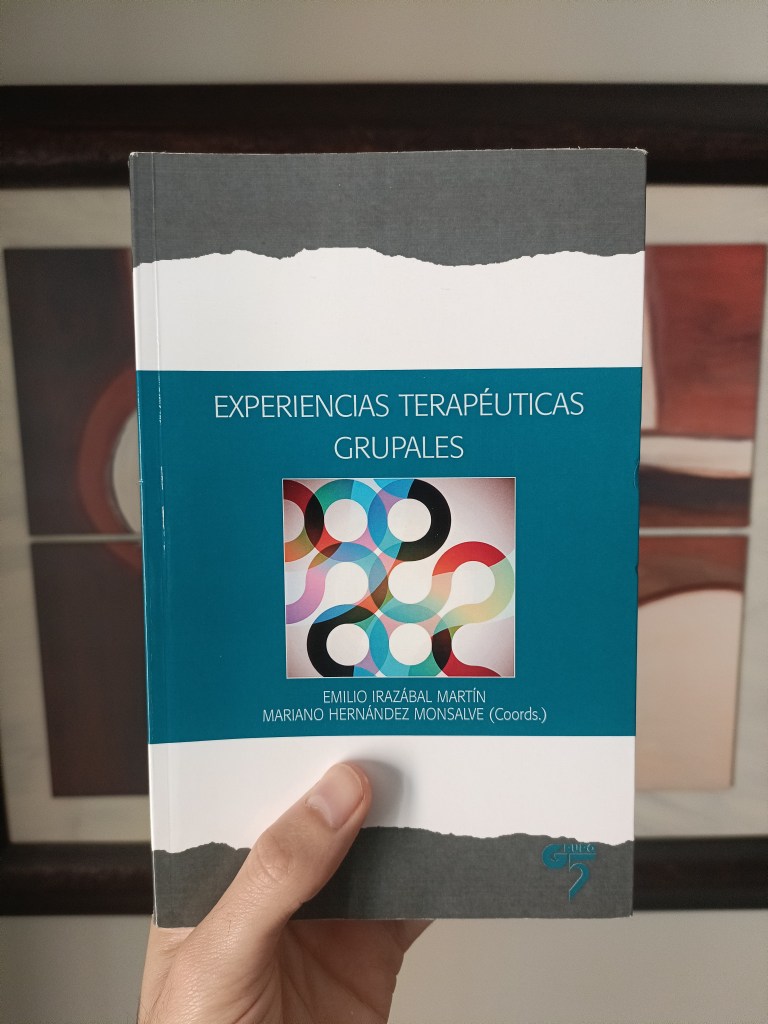
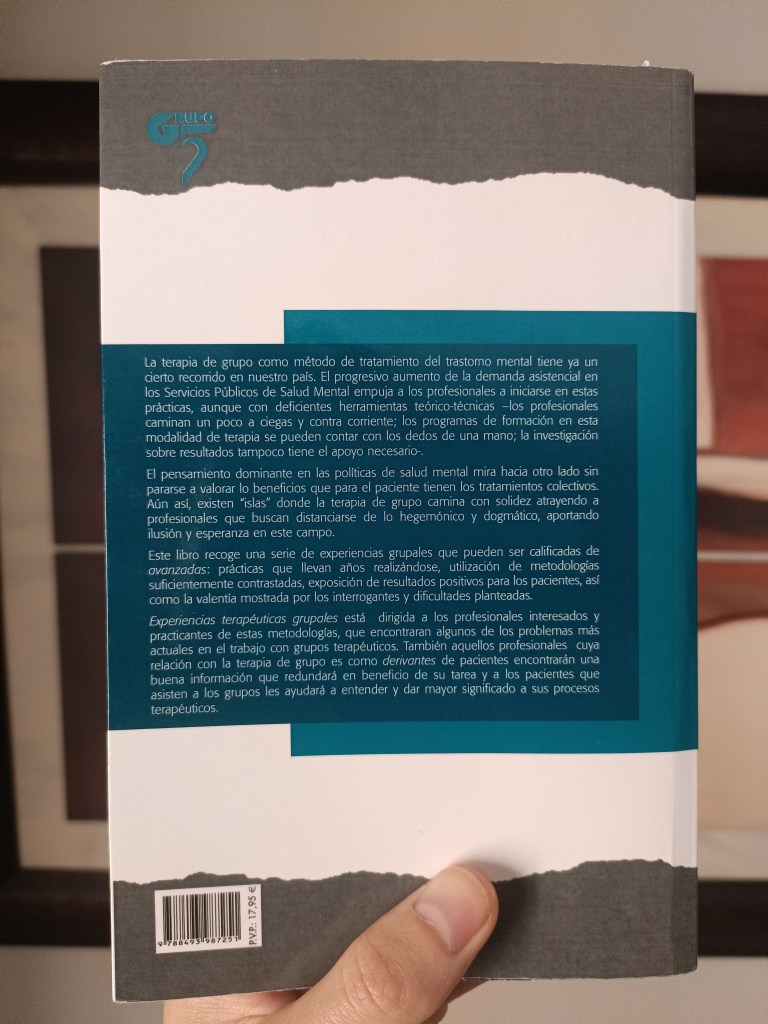
This book is the result of a compilation of scientific papers or essays on group therapy in different areas of mental health.
Thus, this book can be classified within the didactic genre in the form of a set of essays or scientific papers and subclassified among those in the field of Psychology.
This is a single edition published by Editorial Grupo 5, which is a Spanish publishing house that publishes books for the education and training of professionals working in the field of social and health services. This book has not been translated into English.
Publication date: 2013
Country: Spain
Pages: 252
Reading date: September 2022
Rating: 4.25/5
The compilation of the scientific papers published in this book has been coordinated by Emilio Irazábal Martín, who is a clinical psychologist, social psychologist and psychotherapist. However, the set of authors of the essays compiled here amounts to 24, as the book collects the papers presented at the Jornadas sobre Trabajo Grupal en Salud Mental («Conference on Group Work in Mental Health») held in 2011 in Madrid. All of them belong to different public resources and mental health professions. In addition, this book is part of a series called Intersecciones y Fronteras de la Salud Mental («Intersections and Frontiers of Mental Health»), which was directed by the psychiatrist and psychotherapist Mariano Hernández Monsalve.
The other books published in this series are:
Psicoterapia y rehabilitación de pacientes con psicosis (2011)
Within the list of other books published in this series, those for which there is already a post in this blog are highlighted.
Click on it to read it!
I started my internship as an Internal Nurse Resident (EIR) in Mental Health in Zaragoza in July 2021. From this experience I can say that one of the interventions which I have found most complicated and at the same time enriching has been the group work. One of my teaching tutors, during my time at the Psychiatric Day Hospital of the Miguel Servet University Hospital (HUMS), taught me about the functioning of Operative Groups, which I still have a lot to learn more about. Among his recommended readings, she lent me the book I am discussing in this blog entry.
As I mentioned earlier, this book is a compilation of papers presented at the Jornadas sobre Trabajo Grupal en Salud Mental («Conference on Group Work in Mental Health») held in Madrid in 2011. Many professionals from the social and health care field took part in them, so this book also carries such diversity of approaches.
«The patient and his family bring to the unit their own ambivalence in relation to change and their own contradiction between the conscious desire to change and the unconscious determination to defend and maintain their own pathological way of life, to which the patient is necessarily attached, having constituted for him, until now, the only way, albeit unsatisfactory, of living with his own anxieties, conflicts and deficits»
Antonio Tarí García
While it is true that many of the essays in the book are mainly psychoanalytic or psychodynamic in orientation, this is not uniform but rather heterogeneous. There are Kleinians, Lacanians, supporters of the Psychology of the Self, of Psychodrama, of the Operative group concept… Different psychological, philosophical and sociological approaches are present. All of them with a common objective, which is the group.
It is emphasised that group psychoanalysis is «another psychoanalysis», with a different way of organising itself, which should be further developed and put into clinical practice. The concept of «social psychology» is thus mentioned.
«Hospitalisation in a psychiatric unit for acute patients is usually a second traumatic experience in addition to the one that provoked the crisis. The deprivation of freedom (it is a closed unit) and the psycho-hygienic habits, healthy for us, but for the patient imposed and sometimes very different from those at home, easily transform the unit into a hostile environment in his or her imagination. Not to mention the patient’s fantasies and prejudices about what a psychiatric unit is and the fear of being assigned for life the role of a mentally ill person»
Rafael Arroyo Guillamón and Sara del Palacio Tamarit
On the other hand, the diversity in this set of essays can be seen not only in the theoretical approach, but also in many other aspects related to the group setting: age of the patients in the group, the facility where it takes place, patients’ diagnoses, objectives of the group, multi-family groups, topics treated, dilemmas which may arise…. All this breadth of scenarios and the excellent analysis of the group situation, its setting and its development in each chapter, has helped me to become aware of the complexity of good group therapy.
Reflection is essential, not only in terms of the aforementioned group setting, but also in terms of our own performance as professionals towards patients, towards our colleagues and towards ourselves. This emphasis on a good self-criticism of our interventions is something which has left me with a good taste in my mouth after reading this book.
«Patients who are admitted, largely against their will, forcefully exhibit the only thing they possess and can control, the symptom»
«In such mental disorganisation it is frequent that in their first days they oscillate defensively between fight and flight […] Both forms of communication separate and protect them from the other with the same force with which they fervently request help»
Rafael Arroyo Guillamón and Sara del Palacio Tamarit
I would like to highlight one of the chapters which I liked the most: the one in which they explain the setting up and development of a group made up of Day Hospital patients, in which the therapist uses films as psychotherapeutic tools and recounts her experience with the patients.
«We know that sense of humour is one of the most evolved defence mechanisms we humans have. Films often have comic moments which help us to approach problems with less emotional involvement and to relativise our previous stance. Laughter has a great capacity to change mood. Similarly, crying is a form of emotional catharsis; we cry at the cinema because we can vent our grief without being censured for doing so or accused of being weak or inadequate, because «it’s only a film»»
María Martín Martín-Blas
In conclusion, it has been a very motivating book for me to learn about therapy groups. I have not agreed with some statements or ideas in certain chapters, but it has encouraged me to reflect on and become aware of the complexity of group work in Mental Health, and I hope to continue learning from it.
Some reflections:
What does it mean to you to feel part of a group?
Would you say that absolutely all human beings need group social interaction? What do we get out of it? What do we expose ourselves to in it?
What feelings might a person with mental health problems have when interacting with others? How would you act if you were that person?
What would be your biggest concern if you were admitted to a Psychiatric ward in a hospital?
Type your e-mail address and click on subscribe to be notified of new content!










 arquerociego
Which are the latest blog posts?