First sowing
This book is an inclusive handbook that aims at the social empowerment of people with cognitive disadvantages through group activities and dynamics.
It can therefore be classified within the didactic genre in the form of a handbook or practical guide. And if we stick to the purpose of the text, it can be subclassified within the category of the sociopolitical, without ignoring its link with the scientific field of Psychology.
This is a first edition published by Serendipia Editorial, which is a Spanish publishing house that defines itself as heterodox, as it wants to become a space which welcomes creativity and new ideas. It is not translated into English.
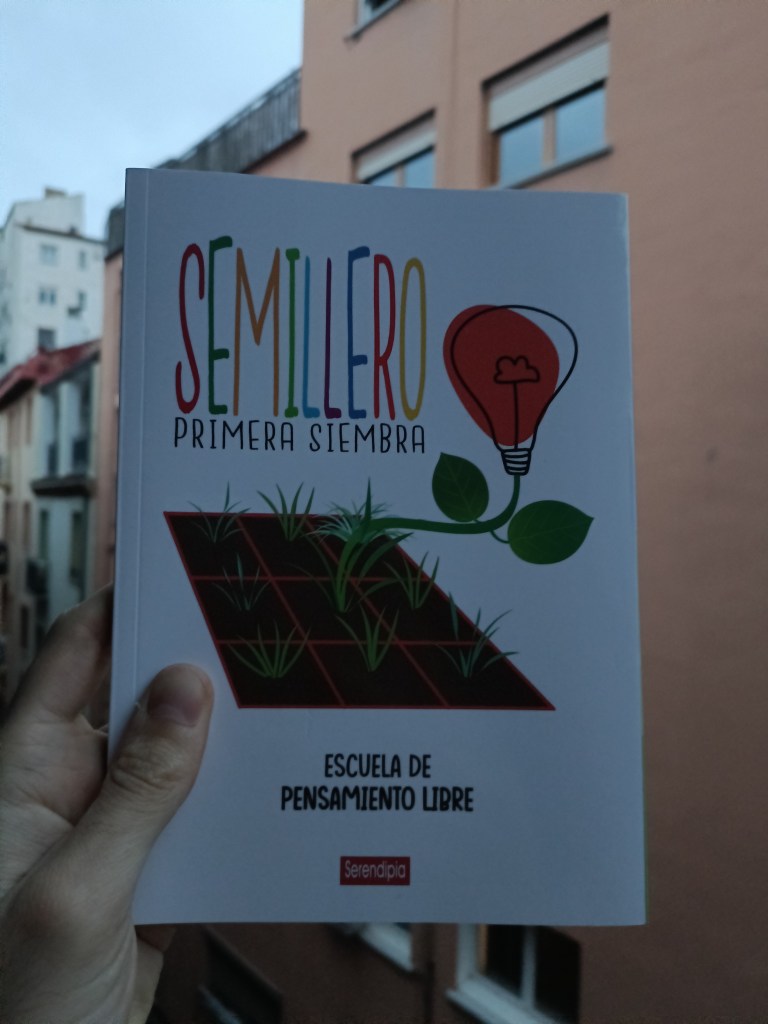
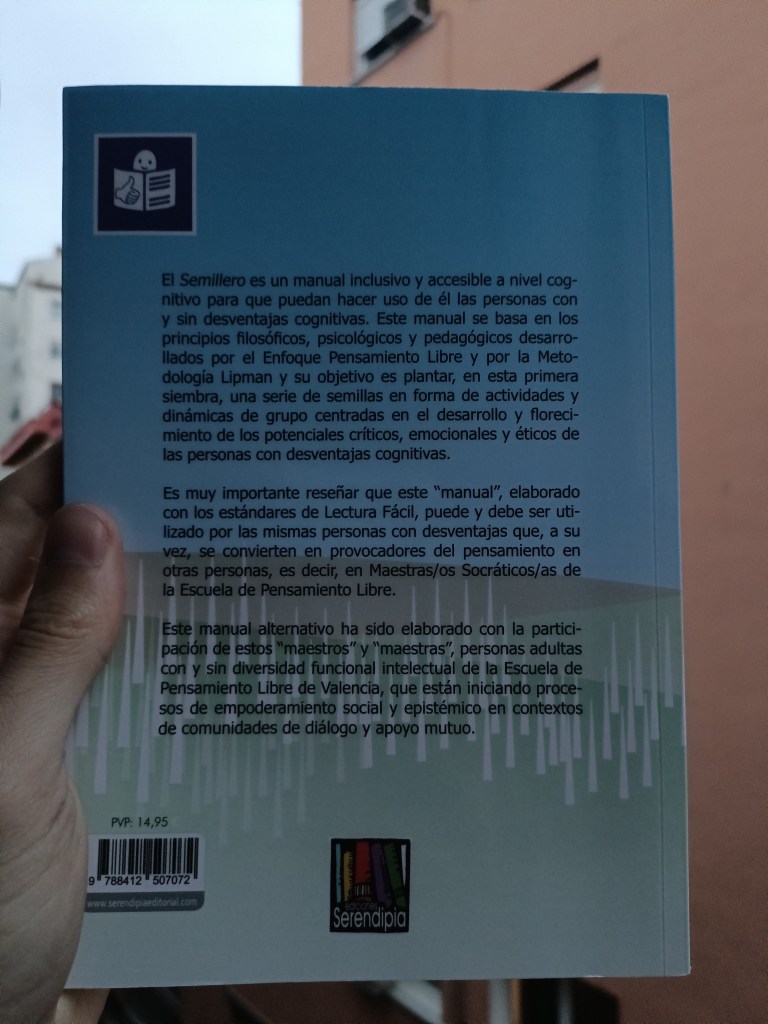
- Publication date: 2022
- Country: Spain
- Pages: 92
- Reading date: February 2023
- Rating: 5/5
The author is the Escuela de Pensamiento Libre (EPL) («School of Free Thought») (Valencia, 2015-). This school was born after a previous experience through the association between Plena Inclusión («Full Inclusion») of Comunidad Valenciana and Filosofía para Niños («Philosophy for Children») of the same Autonomous Community. It consists of an inclusive and participatory space made up of professionals, family members, people with intellectual disabilities and other members of the community whose aim is to learn to think more critically, creatively and ethically. The school’s approach is to train thinking skills more than any specific content, through and reaching empowerment, as part of the teachers of the school itself are also people with disabilities. Thus, it focuses on the potentials and not on the limitations of people. It is currently trying to take its experience to other Autonomous Communities through group seminars tutored by the Escuela de Pensamiento Libre itself. It has several members, among whom for the moment I have only had the pleasure of reading Chema Sánchez.

At the beginning of 2022 I discovered a book by Chema Sánchez in a bookshop in Madrid where I worked as a volunteer for some months time ago. That book was El radiofonista pirado. It was my first contact with a text related to the Escuela de Pensamiento Libre. From then on I started to investigate what Filosofía para Niños was. I discovered their educational approach to be very stimulating and interesting. Since then I have only wanted to learn more about the project and the ideas behind it, as well as about the authors who nurture it.
I have attended some online seminars in Madrid and Castilla-La Mancha thanks to my contact with one of the people who organises them. This has only increased my interest in the project, which was already great because I feel that two of my great passions (Philosophy and Mental Health) come together.
I tried to sign up for the postgraduate course organised by the University of Valencia called Certificado de Formación Continua en Acciones Educativas en Contextos de (Dis)capacidad Intelectual: La Escuela de Pensamiento Libre («Certificate of Continuous Training in Educational Actions in Contexts of Intellectual (Dis)Ability: The School of Free Thought»). However, it did not take place in its 2022 call for applications. I would like to be able to do it in a later call to continue learning and discovering this fascinating world with which I have had the pleasure of coming into contact.
In the meantime, I decided to continue reading about the subject and that is when this book called Seedbed was recommended to me.
«A seedbed is where a seed is placed to be sown. We sow possibilities in people. And we see how people evolve from seed to fruit. This is a seedbed for Socratic Teachers. You can use it to help other people. To sow possibilities in others»
Escuela de Pensamiento Libre
The handbook begins by making clear that it is written according to Easy Reading standards as this increases its accessibility and subsequent possible use by Socratic Teachers. This role consists of a teacher who helps other people with or without cognitive disadvantages to think for themselves in the Escuela de Pensamiento Libre seminars. These seminars last practically a whole day. They teach Critical Thinking, Emotional Education and Values Education, all areas which help to gain confidence, security and freedom of thought.
Having clarified these issues, the book goes on to detail the duration of the work in each of these areas in a Escuela de Pensamiento Libre day, not forgetting the time dedicated to the opening and closing group dynamics.
This is followed by different examples of such group dynamics in each of the aforementioned areas of work.
I found the handbook as a whole enjoyable to read and the group dynamics presented are a first glimpse of the way the school works. Their development, of course, requires practice and training in my experience and opinion.
In conclusion, reading this book has made the Escuela de Pensamiento Libre’s way of teaching clearer to me thanks to the explanation of the different group dynamics they use in their seminars. However, in my opinion, such a reading is enriched if one participates in such group seminars and if one is already familiar with the paradigm in which this school is immersed.
Some reflections:

- What skills make a person a good teacher?
- Is the reflective faculty of thinking valued in our society? Why?
- Are we surprised at the idea of imagining a cognitively disadvantaged person being able to think critically on their own and to share this with others? Why?
- What results can bringing philosophy out of classrooms and universities and into the community have? What impact can this make on mental health?
Type your e-mail address and click on subscribe to be notified of new content!
Which are the latest blog posts?
- I overcame the anorexia
- Yo vencí la anorexia
- Pensando en ellos
- Thinking about them
- Saldremos de esta: Guía de salud mental para el entorno de la persona en crisis
- We will get over this: A mental health guide for the environment of the person in crisis
- Traces of Madness: A Graphic Memoir
- Desmesura: Una historia cotidiana de locura en la ciudad
- When I sing, mountains dance
- Canto yo y la montaña baila
Cambia el idioma a:
 arquerociego